

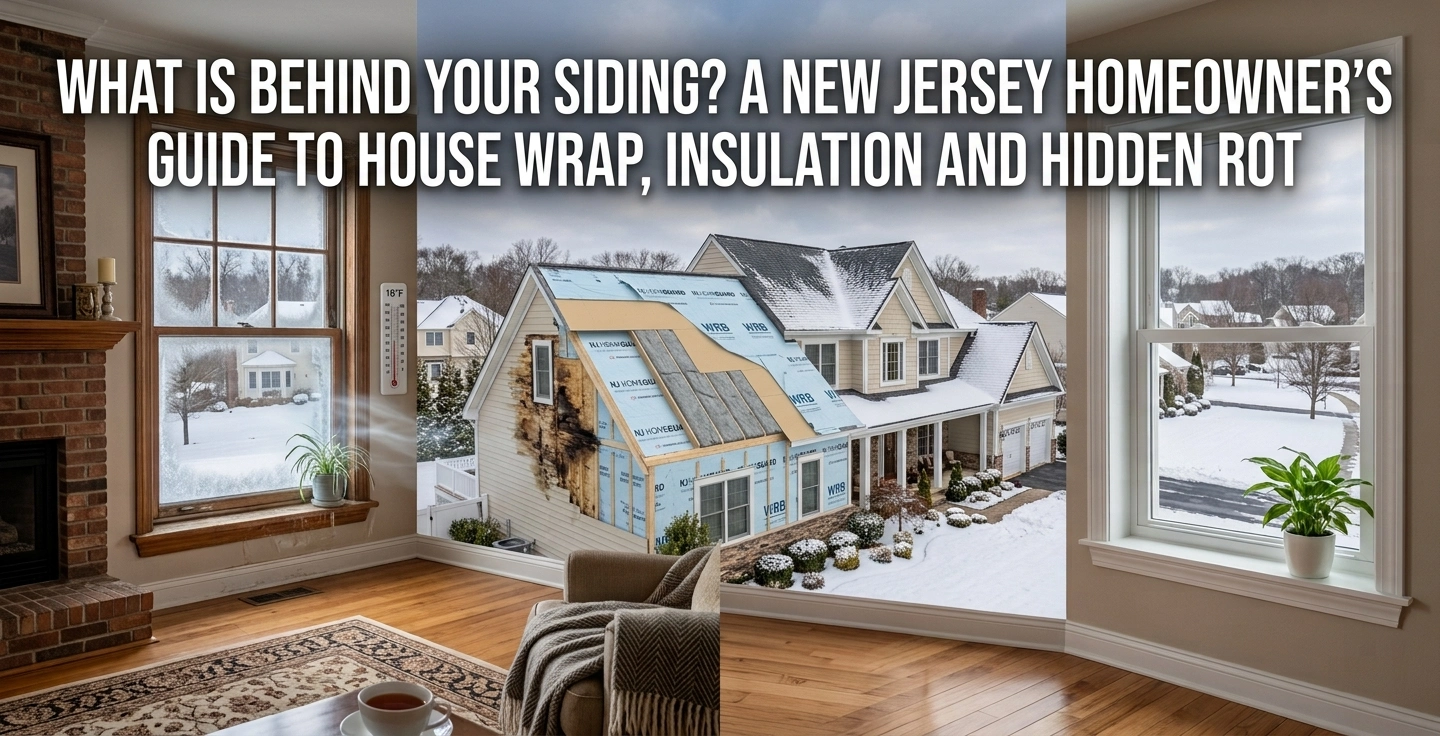
The contractor pulled off a section of vinyl siding on the 1980s colonial and stopped. Behind the siding, there was no house wrap. No insulation. Just bare plywood sheathing with dark, soft spots where moisture had been sitting for years. “This is what we were afraid of,” he said. “The siding has been hiding this for decades.”
That scene plays out thousands of times across New Jersey every year. Homeowners call for a siding replacement and discover that what’s underneath is a lot more complicated — and expensive — than they expected.
This guide explains what’s actually behind your siding, what should be there, what’s often missing, and how to spot hidden problems before they become catastrophic.
The Layers of a Properly Built Wall
From outside to inside, a well-built exterior wall in New Jersey has several layers:
- Siding — your home’s first line of defense (vinyl, fiber cement, wood, etc.)
- Weather-resistant barrier (house wrap or felt) — keeps liquid water out while allowing moisture vapor to escape
- Sheathing — the structural layer (plywood or OSB)
- Wall insulation — keeps your home warm in winter and cool in summer
- Vapor barrier — prevents interior moisture from entering the wall cavity
- Drywall — the interior finish surface
The problem: Many New Jersey homes — especially those built before the 1990s — are missing one or more of these layers.
House Wrap: What It Is and Why It Matters
House wrap is a breathable membrane installed between the sheathing and the siding. It’s designed to:
- Keep liquid water out while allowing water vapor to escape
- Reduce airflow and save energy
- Prevent rot and decay in the wall cavity
The House Wrap Reality in New Jersey
The good news: Modern house wraps like Tyvek are highly effective. When properly installed — taped at seams, flashed around windows and doors — they create a protective envelope around your home.
The bad news: House wrap is not part of standard siding installations for many older homes. If your home was built before the 1990s, there’s a good chance there’s no house wrap behind your siding.
The worse news: Even when house wrap was installed, it may have been improperly done — untaped seams, tears, or gaps around windows and doors that let moisture in.
Insulation: What’s (or Isn’t) Behind Your Walls
New Jersey’s climate demands good insulation. But many homes — especially mid-century ranches and Cape Cods — were built with minimal or no wall insulation.
What You Might Find Behind Your Siding
| Era | Typical Wall Construction | What’s Behind the Siding |
| Pre-1940s | Wood frame with no sheathing | Nothing — just empty wall cavities |
| 1950s–1970s | Plywood sheathing | Minimal or no insulation |
| 1980s–1990s | OSB sheathing, house wrap common | Fiberglass batts (often compressed or settled) |
| 2000s+ | OSB sheathing, house wrap standard | Fiberglass batts or spray foam |
The fix: When you replace siding, it’s the perfect time to add insulation. Rigid foam boards can be installed over the existing sheathing before the new siding goes on. This improves energy efficiency dramatically and is much cheaper than adding insulation from inside.
Hidden Rot: The Expensive Surprise
Here’s the reality: by the time siding looks bad cosmetically, the damage underneath is often significant.
What we find behind New Jersey siding:
- Rotted sheathing where moisture has been trapped for years
- Missing or failed house wrap
- Mold and mildew from trapped moisture
- Termite damage concealed by the siding
- Water damage to wall framing
The cost: Fixing structural damage discovered during siding replacement typically adds $1,000 to $5,000 to the project.
The good news: This work prevents catastrophic failure later. Catching rot early — when you’re already doing siding — is far cheaper than dealing with structural collapse.
Cover-Overs vs. Full Tear-Off: The Critical Decision
Some contractors offer to install new siding over your old siding. This is called a “cover-over” or “overlay.”
Why cover-overs are risky:
- They hide exactly the moisture and rot problems that made the original siding fail
- They add weight to your walls without addressing structural issues
- They trap moisture between the old and new layers
- They make future inspections impossible
The better choice: Full tear-off. Remove the old siding completely, inspect what’s underneath, replace damaged sheathing, install proper house wrap and insulation, and install new siding correctly.
What to Expect When Siding Comes Off
Here’s what a good contractor will do during a full siding replacement:
- Remove all old siding — not just the visible parts
- Inspect the sheathing for rot, mold, or damage
- Replace damaged sheathing (priced per sheet, approved by you before work begins)
- Install new house wrap — taped at seams, properly flashed
- Add insulation if needed (rigid foam over sheathing)
- Install new siding correctly
Cost context: Sheathing replacement in New Jersey typically runs $100–$150 per sheet (4×8 foot panel). Most older homes need 5–20 sheets replaced.
Frequently Asked Questions: What’s Behind Your Siding
1. What is house wrap and why is it important?
House wrap is a breathable moisture barrier installed between sheathing and siding. It keeps liquid water out while allowing water vapor to escape, preventing rot and decay.
2. Does my New Jersey home have house wrap?
If your home was built before the 1990s, probably not. House wrap became common in the 1990s but was not standard before then.
3. How much does it cost to fix hidden rot behind siding?
Structural damage discovered during siding replacement typically adds $1,000–$5,000 to the project. Sheathing replacement runs $100–$150 per sheet.
4. Should I replace siding over old siding or tear it off?
Full tear-off is almost always the better choice. Cover-overs hide moisture and rot problems and can lead to catastrophic failure later.
5. What kind of insulation is best behind siding?
Rigid foam boards installed over existing sheathing are excellent for New Jersey’s climate. They add R-value without requiring interior demolition.
6. How do I know if there’s rot behind my siding?
Signs include: peeling interior paint near exterior walls, bubbling wallpaper, mold or mildew smell, soft spots when pressing on siding, and rising energy bills.
7. Can house wrap be installed during siding replacement?
Yes. Full siding replacement is the perfect time to install house wrap, add insulation, and replace damaged sheathing.
8. What’s the difference between house wrap and a vapor barrier?
House wrap is breathable — it lets moisture vapor escape. A vapor barrier is impermeable and is installed on the interior side of the wall, not behind the siding.
9. How long does siding last in New Jersey?
Vinyl: 20–30 years. Fiber cement: 30–50 years. Wood: 20–40 years with maintenance. New Jersey’s freeze-thaw cycles and humidity shorten lifespan compared to milder climates.
10. What’s the ROI on siding replacement with sheathing repair?
Siding replacement typically recoups 70–85% of its cost at resale. More importantly, addressing hidden rot prevents structural issues that could cost far more later.