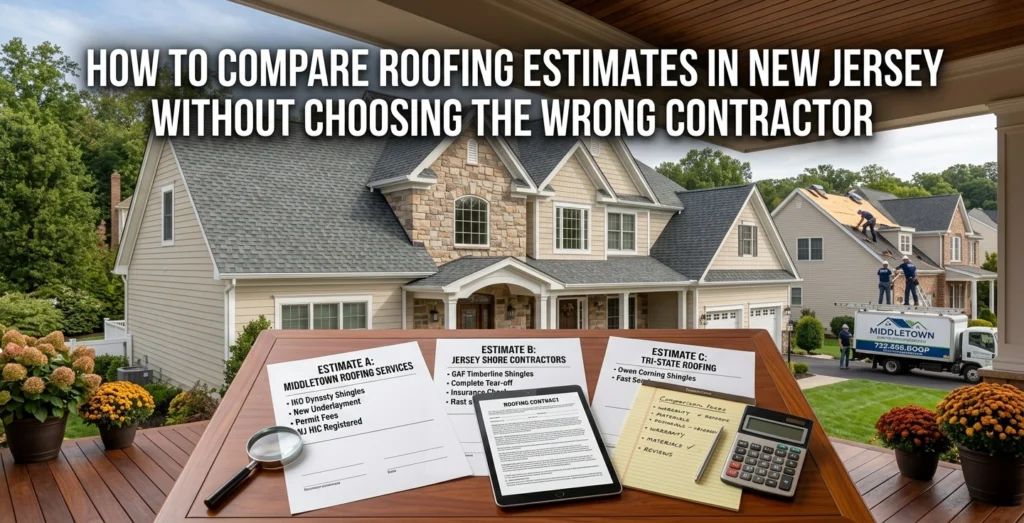


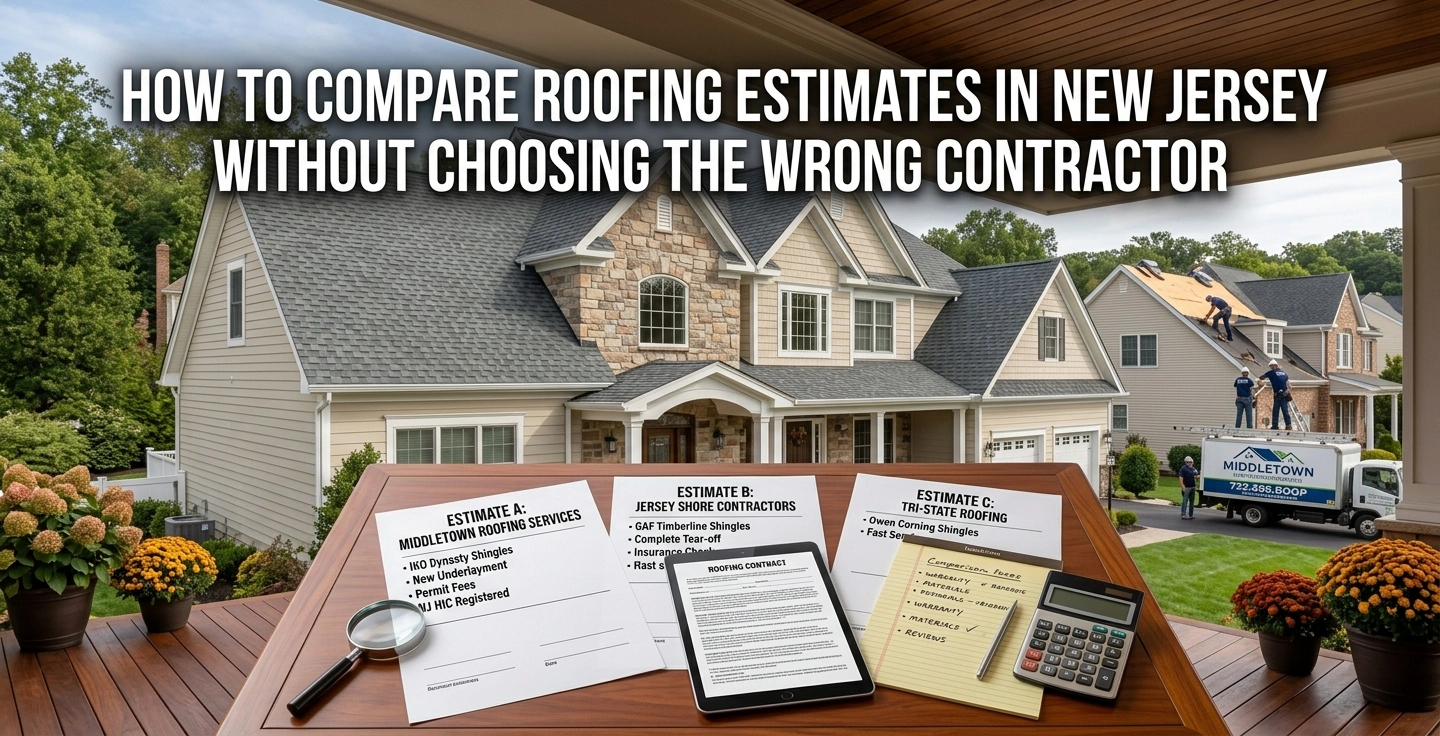
You’ve got three roofing estimates on your kitchen table. One says $9,000. One says $15,000. One says $25,000.
For the same roof.
Now what?
That’s the situation New Jersey homeowners face every day. Roofing quotes in New Jersey can range from $9,000 to $25,000 for the exact same materials. That leaves many homeowners confused.
This guide breaks down how to compare roofing estimates apples-to-apples, spot the red flags, and choose a contractor you can actually trust.
Step 1: Verify Contractor Credentials First — Before Comparing Numbers
Before you even look at the bottom line, verify the basics:
- New Jersey license — Verify through the New Jersey Division of Consumer Affairs website
- General liability insurance — Ask for certificates
- Workers’ compensation insurance — Protects you if a worker is injured on your property
- Manufacturer certifications — GAF, Owens Corning, CertainTeed certifications indicate quality
- Local references and reviews — Look for recent reviews from your area
Red flag: If a quote omits business credentials, move on. A legitimate roofer will share this information upfront.
Step 2: Get At Least Three Estimates
Obtaining at least three quotes helps you:
- Understand the price range for your project
- Spot differences in materials, labor, and warranties
- Avoid being overcharged or underquoted with corners cut
- Identify red flags in professionalism and communication
Comparing estimates isn’t just about choosing the lowest bid — it’s about knowing exactly what you’re paying for.
Get Estimate Now
Step 3: Ensure the Scope of Work Matches
Every estimate should clearly state what is included. Review line by line for:
| What to Look For | Why It Matters |
| Full tear-off vs. overlay | Full tear-off is better long-term |
| Underlayment type | Synthetic is better than 15 lb felt |
| Ice and water shield | Essential on eaves, valleys, and penetrations |
| Ventilation system | Ridge vents, soffit vents |
| Drip edge and flashing | Critical for water protection |
| Cleanup and debris removal | Should be included |
| Permits and inspections | Who handles them? |
Red flag: Vague descriptions or skipped items may indicate hidden costs later.
Step 4: Compare Roofing Materials — Not Just the Bottom Line
Not all shingles or roofing systems are the same. Make sure you’re comparing similar materials:
| What to Compare | Why It Matters |
| Shingle type | 3-tab vs. architectural vs. premium |
| Brand | GAF, CertainTeed, Owens Corning |
| Wind rating | 130 mph vs. lower ratings |
| Algae resistance | Essential for New Jersey’s north-facing slopes |
| Underlayment | Ice and water shield vs. basic felt |
| Manufacturer warranty | 20–50 years, limited vs. full |
| Workmanship warranty | 1 year vs. 10 years vs. lifetime |
Critical: Cheaper materials may reduce the estimate but also shorten lifespan or void warranties. Always confirm that the same brand and style are included in all quotes.
Get Estimate Now
Step 5: Compare Labor and Installation Methods
Quality labor is as critical as materials. Ask each contractor:
- How many roofers will be on-site?
- How long will the job take?
- Will the old roof be removed?
- Will damaged decking be replaced if needed?
- Are roofing nails or staples used?
Red flag: Lower labor costs often mean smaller crews, rushed work, or skipped steps — especially with storm chasers or out-of-town crews.
Step 6: Review Warranties and Guarantees
Ask contractors to specify:
- Manufacturer warranties — 20–50 years, but read the fine print (prorated vs. non-prorated)
- Workmanship warranties — 1 year is bare minimum; 5–10 years is better
- What voids the warranty — Poor attic ventilation is a common issue
- Transferability — Can the warranty transfer to a new owner if you sell?
Red flag: A contractor who won’t put the warranty in writing or who gives vague answers about coverage.
Step 7: Review Payment Terms and Hidden Fees
Review the payment structure:
- Down payment amount (should be reasonable, not the full project cost)
- Payment schedule (tied to progress, not just dates)
- Final balance (due after completion and inspection)
Red flag: A contractor who asks for full payment upfront or who has no clear payment schedule.
Step 8: Research Reputation
Read reviews on:
- Google Reviews
- Better Business Bureau (BBB)
- Local Facebook groups
- Nextdoor
Red flag: Consistent negative feedback — especially from homeowners in your area — says more than any marketing brochure.
Step 9: Ask About Crew and Process
Is the roofer using an in-house team or subcontractors? Reliable companies handle projects internally to maintain quality control and accountability.
Step 10: Don’t Just Focus on Price
Cheap quotes often mean corners cut — thinner underlayment, rushed labor, or missing warranty coverage. The best value combines fair pricing, proven experience, and durable materials.
Step 11: Get It All in Writing
Your contract should include:
- Payment terms
- Start and completion dates
- Warranty details
- Cleanup commitments
- Material specifications (brand, type, color)
Rule: If it’s not written down, it doesn’t count.
Step 12: Trust Your Gut
If something feels off — it probably is. Roofing is a big investment, and you deserve to feel confident about who’s working on your home.
Frequently Asked Questions: Comparing Roofing Estimates in NJ
1. Why do roofing estimates vary so much in New Jersey?
Roofing quotes can range from $9,000 to $25,000 for the same roof. Differences come from materials (3-tab vs. architectural vs. premium), underlayment (felt vs. synthetic), labor costs, warranty coverage, and whether the contractor is a legitimate local company or a storm chaser.
2. How many roofing estimates should I get?
At least three. This helps you understand the price range, spot differences in materials and labor, and identify red flags.
3. What should a roofing estimate include?
A detailed scope of work: full tear-off vs. overlay, underlayment type, ice and water shield, ventilation, drip edge and flashing, cleanup, permits, material brand and type, and warranty details.
4. Should I choose the lowest bid?
Not automatically. Cheap quotes often mean corners cut — thinner underlayment, rushed labor, or missing warranty coverage. The best value combines fair pricing, proven experience, and durable materials.
5. How do I verify a New Jersey roofing contractor’s license?
Verify through the New Jersey Division of Consumer Affairs website. Every legitimate contractor should have a valid NJ license.
6. What’s the difference between a manufacturer warranty and a workmanship warranty?
Manufacturer warranty covers material defects (20–50 years). Workmanship warranty covers the installation (1–10+ years). You need both.
7. What are the red flags in a roofing estimate?
Vague descriptions, missing line items, no material brand specified, no underlayment mentioned, no warranty details, and a price that’s significantly lower than competitors.
8. Should I use a storm chaser roofer?
No. Storm chasers often use out-of-town crews, offer low prices, do rushed work, and disappear when problems arise. Always use a local contractor with a physical address in New Jersey.
9. What happens if my roofer finds rotted decking during tear-off?
The contract should include a per-sheet price for OSB or plywood replacement. You pay only for what is actually needed. A good contractor shows you photos before replacing.
10. How long should a roof replacement take in New Jersey?
A typical home takes 2–4 days. More complex roofs take 3–5 days. Be wary of a contractor who promises the job in one day — that usually means rushed work.