

The homeowner in the Lincroft section of Middletown had two estimates on the kitchen table. One was for vinyl siding — $14,000. The other was for James Hardie fiber cement — $26,000. “I know the Hardie looks better,” she said. “But is it really worth $12,000 more?”
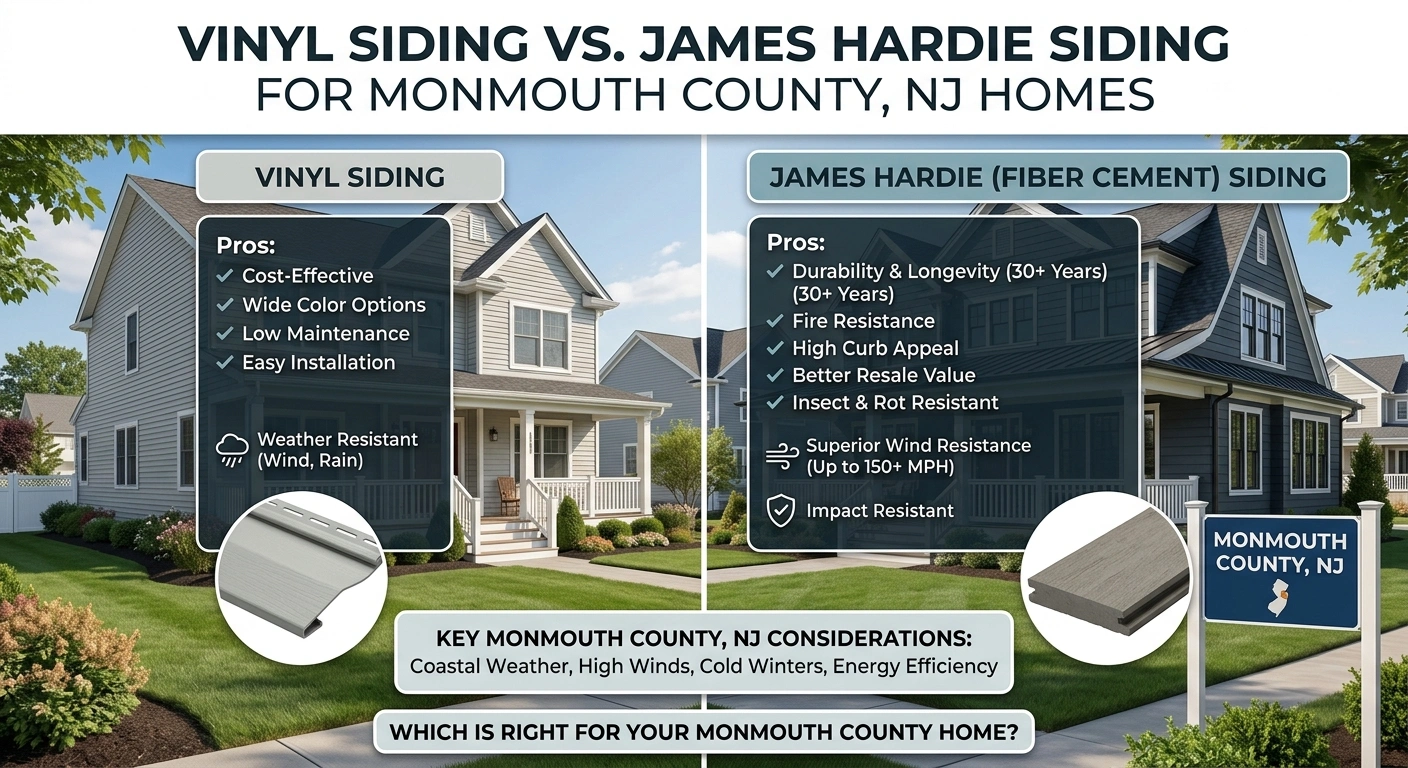
That is the question Monmouth County homeowners ask every week. Vinyl siding is everywhere. It’s affordable and virtually maintenance-free. James Hardie fiber cement costs significantly more but promises superior durability, better curb appeal, and higher resale value. Which one actually makes sense for your house?
This guide breaks down the real differences between vinyl and James Hardie siding for Monmouth County homes in 2026 — cost, lifespan, maintenance, and long-term value.
The Quick Comparison
| What You’re Comparing | James Hardie | Vinyl |
| Upfront Cost | $$$$ | $$ |
| How Long It Lasts | 30–50 years | 20–30 years |
| Maintenance | Low (repaint every 15–20 years) | Almost none |
| Fire Resistance | Won’t burn | Melts |
| Impact Resistance | Solid | Can crack in cold |
| Resale Value Boost | 5–7% | 2–3% |
| Warranty | 30 years | “Lifetime” (with limits) |
Source: Industry data for PA/NJ homes
Cost Comparison: What You Actually Pay
For a typical 2,000 sq ft Monmouth County home, here is what each siding type costs installed:
| Siding Type | Cost Per Square Foot Installed | Typical 2,000 sq ft Home |
| Standard Vinyl Siding | $8.50 – $11.00 | $17,000 – $22,000 |
| James Hardie Fiber Cement | $11.50 – $18.00 | $23,000 – $36,000 |
On a 2,000 sq ft home with moderate complexity, the cost difference between vinyl and HardiePlank typically runs $14,000–$18,000. James Hardie fiber cement siding costs $10–$15 per square foot installed, while vinyl siding costs $4–$8 per square foot.
Get Estimate Now
James Hardie typically costs 60–80% more upfront than vinyl.
The Case for James Hardie Fiber Cement
What It Does Well
It handles Monmouth County weather. Fiber cement doesn’t care about freeze-thaw cycles. It won’t warp, won’t rot, and won’t let termites through. After 20 years, it looks pretty much like year one.
It doesn’t burn. Fiber cement is a cement-based product — non-combustible. Your grill mishap or a neighbor’s fire won’t take your siding with it.
ColorPlus actually works. James Hardie’s factory-applied color is baked on in controlled conditions. It’s not paint sitting on top — it’s part of the finish. Fifteen-year color warranty because they know it holds.
It looks like whatever you want. Wood grain, smooth, shingle-style. From the curb, you can’t tell it’s not the real thing.
It helps resale. Studies show 75–85% cost recovery at sale. In nicer neighborhoods, sometimes more. Buyers notice.
The Downsides
More expensive. No getting around it — $10–$15 per square foot installed versus $4–$8 for vinyl.
Heavier installation requires skill. Botched fiber cement installations create problems. You need a crew that’s done it before.
If you don’t choose ColorPlus, you’re painting. Some people want custom colors. That’s fine, but know you’re committing to paint maintenance.
The Case for Vinyl Siding
What It Does Well
Affordable. If budget is your primary constraint, vinyl gets you new siding at roughly half the cost of fiber cement.
Basically maintenance-free. No painting ever. Hose it off once a year if you feel like it. That’s it.
Quick install. Lighter material, more forgiving process. Jobs go faster.
Lots of options. Colors, textures, profiles — vinyl manufacturers make everything.
The Downsides
Cracks in cold snaps. Monmouth County winters stress vinyl. Contractors see cracked panels every spring.
Melts near heat. Your grill too close to the house, sunlight reflecting off a neighbor’s window — vinyl can deform.
Fades eventually. Five years in, you can tell. Ten years in, it’s obvious. The “lifetime warranty” doesn’t cover fading.
Which One Should You Choose for Your Monmouth County Home?
Choose James Hardie if:
- You plan to stay in your home for 10+ years
- You want the best possible curb appeal
- You’re in a higher-end neighborhood (Lincroft, Rumson, Fair Haven)
- You want maximum resale value
- You want fire resistance and impact resistance
Choose Vinyl if:
- Budget is your primary constraint
- You plan to sell within 5–7 years
- Your home is in a less visible location
- You want the absolute lowest maintenance option
The “Forever Home” Philosophy: If you plan on living in your home for less than five years, the premium cost of James Hardie might not be fully realized in your tenure. However, if this is your “forever home,” Hardie is almost always the better long-term investment.
Frequently Asked Questions: Vinyl vs. James Hardie Siding
1. How much more does James Hardie cost than vinyl?
James Hardie typically costs 60–80% more upfront than vinyl. On a 2,000 sq ft home, the difference is roughly $14,000–$18,000.
2. How long does each siding type last?
James Hardie: 30–50 years. Vinyl: 20–30 years.
3. Does James Hardie increase home value?
Yes. Studies show 75–85% cost recovery at sale. In nicer neighborhoods, sometimes more.
4. Does vinyl siding fade?
Yes. Five years in, you can tell. Ten years in, it’s obvious. James Hardie’s ColorPlus finish has a 15-year color warranty.
5. Which is better for coastal Monmouth County?
James Hardie. Fiber cement handles salt air better than vinyl and won’t corrode or warp in coastal conditions.
6. Do I need a permit for siding replacement in Monmouth County?
Under NJ UCC, siding for one- and two-family detached dwellings is generally exempt from permits (except polypropylene). However, homes in Historic Districts still require review.
7. Can vinyl siding crack in cold weather?
Yes. Monmouth County winters stress vinyl. Contractors see cracked panels every spring