

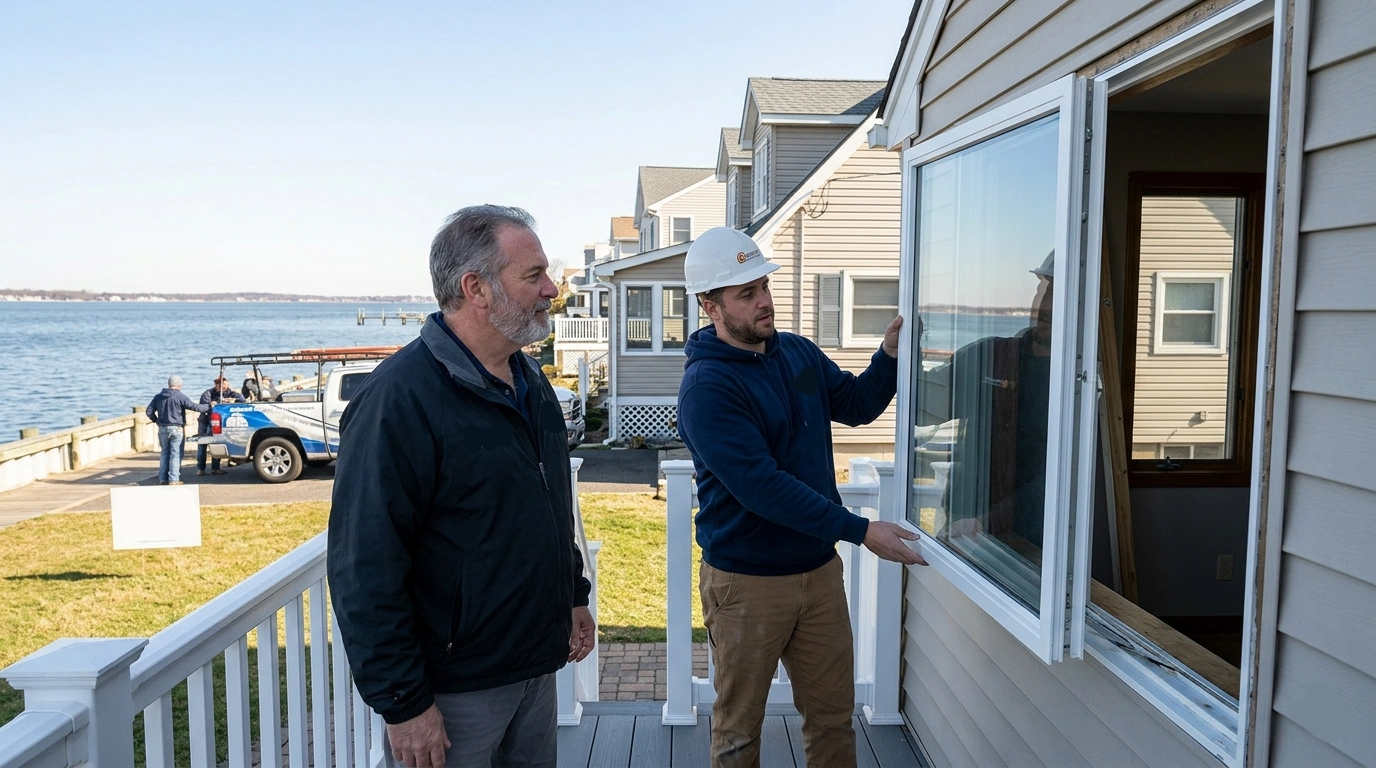
The wind off Raritan Bay was steady the morning the contractor arrived at the Victorian on Front Street. He walked to the southeast elevation and pressed a screwdriver into the wood siding near the bottom corner. It went in two inches without resistance. “This is rot, not paint failure,” he said. “The salt air has been wicking up behind the siding for years. The sheathing behind this section is compromised all the way up to the sill plate.”
That is the Keyport reality. The borough sits on Raritan Bay with direct water exposure. The views are spectacular. The salt air is relentless. Homes here face wind-driven rain, salt spray, and coastal moisture year-round. Siding that lasts 30 years in inland towns might fail in 10–15 years in Keyport’s waterfront exposure.
This guide covers what siding replacement actually costs in Keyport in 2026, why waterfront material choices are non-negotiable, how Keyport’s historic homes require special attention, and how to find a contractor who understands salt air.
Why Keyport Homeowners Are Replacing Siding in 2026
Keyport has three distinct housing types, and each is hitting siding replacement age for different reasons.
Waterfront Victorians and historic homes (along Front Street and near the bay) have original wood siding or aluminum added in the 1960s–1980s. The wood has been painted and repainted for over a century; the salt air has been eating it from behind for decades. The aluminum has corroded at panel laps where salt moisture has been trapped.
Mid-century ranches and Cape Cods (in the neighborhoods above the waterfront) have vinyl siding from the 1980s–1990s. Vinyl does not rust, but it becomes brittle from UV exposure, and Keyport’s bay reflections intensify UV degradation. Panels crack, warp, and fade unevenly.
Newer homes and second-floor additions (built for water views) were often sided with commodity vinyl to save costs during the building boom. That cheap vinyl is now failing after only 15–20 years.
The waterfront factor changes everything. Keyport homes face salt spray, wind-driven rain, and constant moisture. The siding isn’t just aesthetic — it’s the primary barrier between your home’s structure and the elements. When Keyport siding fails cosmetically, the damage underneath is often severe.
How Much Does Siding Replacement Cost in Keyport, NJ in 2026?
Keyport pricing is elevated due to waterfront material requirements and older home complexity.
| Siding Type | Material per sq ft | Full Home (2,000 sq ft) | Keyport Context |
| Vinyl (standard) | $4 – $9 | $10,000 – $18,000 | Not recommended for waterfront exposure |
| Vinyl (insulated, coastal-grade) | $7 – $12 | $15,000 – $24,000 | Marginal; fades and fails in 10–15 years |
| Fiber cement (James Hardie, Allura) | $8 – $15 | $18,000 – $32,000 | Recommended for waterfront homes |
| Engineered wood (LP SmartSide) | $7 – $13 | $16,000 – $28,000 | Good waterfront option; lighter than fiber cement |
| Cedar shake / wood | $12 – $20 | $25,000 – $45,000 | Authentic but high maintenance; not recommended |
| Stucco (waterfront-specific mix) | $10 – $18 | $22,000 – $40,000 | Rare in Keyport; requires special coastal mix |
Full home estimates (2,000 sq ft typical colonial or Victorian):
- Fiber cement: $20,000 – $30,000
- LP SmartSide: $18,000 – $26,000
- Insulated vinyl (coastal-grade): $16,000 – $22,000 (but not recommended for waterfront)
Keyport context:
- Waterfront Victorians with architectural detail add $5,000–$10,000 for trim work
- Homes directly on Front Street (full bay exposure) require enhanced moisture barriers
- Sheathing replacement is common (10–25% of waterfront homes need significant decking repair)
What Are the Signs Your Keyport Home Needs Siding Replacement?
Waterfront homes fail differently than inland homes. Here is what to look for in Keyport specifically.
On Vinyl Siding (Common on 1980s–2000s homes)
- Panels that flex or ripple when pressed (not just cosmetic — indicates failed attachment)
- Cracking on south and west exposures (UV damage intensified by bay reflection)
- Fading that is uneven across elevations (the bay-facing side fades fastest)
- Visible gaps at corners or around windows and doors
- Mold or mildew growing behind panels visible from underneath
On Aluminum Siding (Common on 1960s–1980s homes)
- White chalky residue on the surface (aluminum oxidation accelerated by salt air)
- Corrosion visible at panel laps, especially on the southeast elevation
- Panels that feel loose or rattle in wind off the bay
- Interior walls that feel cold or damp on windy days
- Paint that fails within 2–3 years despite proper preparation
On Wood Siding (Common on historic waterfront Victorians)
- Paint that bubbles, peels, or cracks within 1–2 years of application
- Soft spots detectable by pressing a screwdriver into the wood
- Visible rot at the bottom edges of panels and around windows
- Interior moisture staining on walls near the floor
On Any Siding in Keyport
- Rising energy bills with no other changes (siding failure allows air infiltration)
- Peeling interior paint near exterior walls (moisture migration from bay exposure)
- Visible daylight through siding gaps from inside the basement or crawl space
- Neighbors replacing siding (strong indicator yours is also compromised)
Fiber Cement vs. Vinyl vs. Engineered Wood: What Works on the Waterfront?
This is the most important decision for Keyport homeowners. The wrong choice fails in 7–10 years. The right choice lasts 30–50 years.
Fiber Cement (James Hardie, Allura) — STRONGLY RECOMMENDED
Why for Keyport: Fiber cement is inert. It does not rot, does not warp, does not melt, and does not corrode in salt air. It handles wind-driven rain better than any other siding material. It can be manufactured with profiles that match Victorian architectural detail.
Lifespan: 30–50 years
Cost: $$$ (high but worth it)
Drawbacks: Heavy (requires experienced installers), more expensive than vinyl
Keyport note: James Hardie’s ColorPlus finish is pre-painted and holds up to waterfront UV significantly better than field-painted fiber cement. The premium is worth paying on bay-facing elevations.
LP SmartSide (Engineered Wood) — GOOD WATERFRONT OPTION
Why for Keyport: Treated with zinc borate to resist rot and termites. Lighter than fiber cement. Handles impacts better. More forgiving to install on complex Victorian trim work.
Lifespan: 25–40 years
Cost: $$–$$$ (moderate to high)
Drawbacks: Not as moisture-resistant as fiber cement in extreme waterfront exposure
Keyport note: LP SmartSide is a solid second choice if fiber cement is out of budget. But on homes directly on Front Street with full bay exposure, fiber cement is still better.
Vinyl (Even Coastal-Grade) — NOT RECOMMENDED
Why not for Keyport: Vinyl expands and contracts significantly with temperature. In waterfront freeze-thaw cycles, this causes panel movement at laps, allowing moisture intrusion behind the siding. Salt air accelerates UV degradation; vinyl fades unevenly within 5–7 years. Wind-driven rain finds its way behind vinyl laps.
Lifespan: 15–25 years (inland), 10–15 years (waterfront Keyport)
Cost: $–$$ (low to moderate)
Drawbacks: Brittle in cold, fades in sun, allows moisture behind panels, looks cheap on historic homes
Keyport note: Do not accept vinyl on a primary residence in Keyport, especially on Front Street or anywhere with bay exposure. Fiber cement is the correct waterfront specification.
Keyport’s Historic Homes and Siding Choices
The historic homes on Front Street and near the downtown have architectural detail that commodity siding destroys.
What makes a home “historic” in Keyport context:
- Built before 1940 (Victorians, colonials, and waterfront homes)
- Original wood siding with decorative trim, fish scales, or corner boards
- Located in the older sections near the bay (Front Street, Main Street, Broad Street)
What changes for siding replacement on historic Keyport homes:
- Vinyl is almost always inappropriate (looks wrong, fails faster, destroys character)
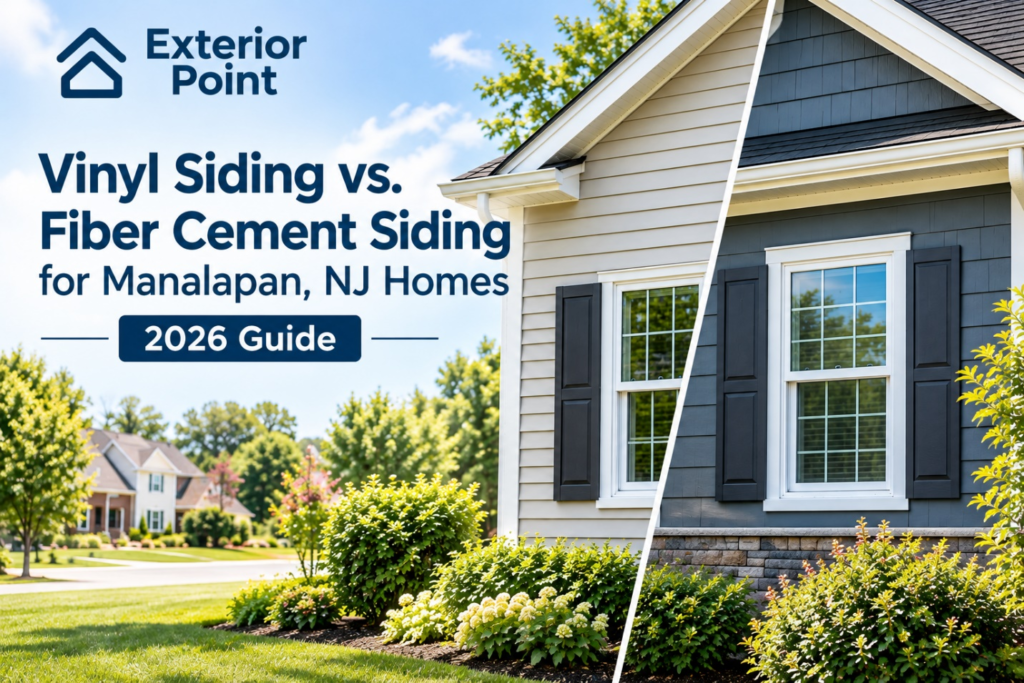
- Fiber cement can be manufactured with bevel, Dutch lap, or shingle profiles that match original details
- Trim work (corner boards, window surrounds, frieze boards) must be preserved or replicated in fiber cement or wood
- Keyport does not have a formal historic district permit process like Red Bank, but curb appeal matters enormously on waterfront homes
Practical advice: Do not strip historic wood siding and replace it with cheap vinyl. Future buyers of historic Keyport homes are looking for authenticity, not the cheapest exterior. Spend the extra money on fiber cement with matching profiles.
Do You Need a Permit for Siding Replacement in Keyport, NJ?
Yes. Full siding replacement requires a construction permit under New Jersey’s Uniform Construction Code.
What requires a permit:
- Full siding replacement on any elevation
- Replacement of sheathing discovered during tear-off
- Any work that involves removing and replacing more than 25% of an exterior wall surface
What does NOT require a permit:
- Minor panel repairs (under 100 sq ft per elevation)
- Painting or cleaning existing siding
Waterfront-specific: Keyport’s waterfront homes may have additional coastal construction requirements (flashing, moisture barriers). Your contractor should be familiar with these.
The Keyport process:
- Your contractor pulls the permit with the borough building department
- Inspection follows completion (house wrap, flashing, attachment method)
- Waterfront homes may have additional scrutiny
Never hire a siding contractor who suggests skipping the permit. It protects you and creates a record for future buyers.
Real Project: Siding Replacement in Keyport, NJ
Case Study: Front Street Waterfront Victorian, Keyport
Property: 2,300 sq. ft. Victorian, built 1895
Location: Front Street, Keyport, Monmouth County (direct Raritan Bay exposure)
Pre-Project Condition: Original wood siding on the front facade with multiple layers of paint. Aluminum siding on rear and side elevations, installed approximately 1978, showing extensive corrosion at panel laps on the bay-facing elevation. Homeowner reported drafts and had seen interior paint peeling near exterior walls in two rooms.
Homeowner Goal: Stay in the home for another 20+ years. Wants a maintenance-reduced exterior that respects the home’s historic character and handles bay exposure.
Findings:
- Full tear-off revealed deteriorated sheathing on the bay-facing elevation (approximately 250 sq ft of soft plywood)
- Moisture barrier was either missing or failed in multiple sections
- Original wood trim (corner boards, window surrounds) was salvageable but required significant repair on the bay-facing side
Solution:
- Complete siding tear-off (aluminum + original wood on front)
- Sheathing replacement on bay-facing elevation (250 sq ft)
- New high-performance moisture barrier (waterfront-grade WRB with drainage plane)
- James Hardie fiber cement siding in bevel profile, factory-finished (ColorPlus) in a period-appropriate cream
- Original wood trim repaired and retained on front facade; new Hardie trim on rear and sides
- All window and door flashing replaced with marine-grade materials
Project Sequence:
Days 1–2: Tear-off and dumpster
Days 3–4: Sheathing replacement and moisture barrier
Days 5–8: Fiber cement installation (bay-facing elevation prioritized)
Days 9–10: Trim, caulking, cleanup, inspection
Total Project Cost: $34,800
- Tear-off and disposal: $3,500
- Sheathing replacement (250 sq ft): $2,500
- Moisture barrier: $1,800
- James Hardie siding + trim: $17,500
- Labor (10 days, 4-person crew): $8,000
- Marine-grade flashing: $1,200
- Permit and fees: $300
- Contingency (actual): $0 under
Result: Home passed Keyport inspection. The homeowner reported immediately noticeable reduction in drafts. The fiber cement siding has held up through two coastal storms with no moisture intrusion. The home’s curb appeal from the bay is significantly improved.
How Do I Find a Trusted Siding Contractor in Keyport, NJ?
Keyport’s waterfront location demands a contractor who understands coastal installation. Here is how to find the right one.
Verify Before Scheduling:
- NJDCA contractor license — verify at njconsumeraffairs.gov
- General liability and workers compensation — ask for certificates
- Physical address or established history in Monmouth County
- Reviews from Keyport, Union Beach, Keansburg, or Hazlet from the past 12 months
Questions to Ask for a Keyport Siding Project:
- Do you have experience with waterfront siding installation in Keyport?
- What materials do you recommend for salt air exposure and why?
- Do you use house wrap, and what type? (Waterfront needs drainage plane, not just felt)
- Will you handle the permit filing with Keyport Borough?
- Do you subcontract labor, or do you have W-2 employees?
- Can you provide three references from waterfront homes in Keyport or nearby?
- What does your labor warranty cover, and for how long?
Red Flag Responses:
- “Standard vinyl is fine for the waterfront” (false — fiber cement is recommended)
- “You don’t need a permit in Keyport” (false — permits are required)
- “All fiber cement is the same” (false — quality varies)
- “We can do your siding in 4 days” (possible on simple homes but unlikely on Victorians)
FAQ Section: Siding Replacement in Keyport, NJ (15 Questions)
1. How much does siding replacement cost in Keyport, NJ in 2026?
Most Keyport homeowners pay between $18,000 and $32,000 for fiber cement siding on a typical 2,000 sq. ft. home. Waterfront homes with direct bay exposure run toward the upper end. Vinyl (not recommended for waterfront) runs $10,000–$18,000. LP SmartSide runs $16,000–$28,000. Historic Victorians with architectural detail add $5,000–$10,000.
2. What is the best siding material for Keyport’s waterfront?
Fiber cement (James Hardie or Allura) is strongly recommended for waterfront Keyport homes. It is inert — it does not rot, warp, or corrode in salt air, and it handles wind-driven rain better than any other material. LP SmartSide is a good second choice. Vinyl is not recommended for waterfront exposure — it fades unevenly within 5–7 years and allows moisture behind panels.
3. Do I need a permit for siding replacement in Keyport?
Yes. Full siding replacement requires a construction permit under NJ UCC. Your contractor should pull the permit and schedule the inspection. Minor repairs (under 100 sq ft per elevation) do not require a permit. Never hire a contractor who suggests skipping the permit.
4. How long does siding replacement take in Keyport?
A typical home takes 7–12 working days. Simple ranch or Cape Cod: 7–8 days. Historic Victorian with complex trim work: 10–14 days. Projects with significant sheathing replacement (common in waterfront homes) add 2–3 days. Weather delays are common in coastal spring and fall.
5. Why is vinyl siding not recommended for Keyport’s waterfront?
Vinyl expands and contracts significantly with temperature. In waterfront freeze-thaw cycles, this causes panel movement at laps, allowing moisture intrusion behind the siding. Salt air accelerates UV degradation; vinyl fades unevenly within 5–7 years. Wind-driven rain from nor’easters finds its way behind vinyl laps. Fiber cement is the correct waterfront specification.
6. Does siding replacement increase home value in Keyport?
Yes, significantly. Keyport buyers are educated about waterfront moisture damage. Failed siding (especially vinyl or corroded aluminum) generates large repair credits or cancelled contracts. New fiber cement siding tells buyers the home has been properly protected from bay exposure. The ROI is typically 70–85% at resale in this waterfront market.
7. What are the signs my Keyport home needs siding replacement?
On vinyl: panels that flex or ripple, cracking on south/west exposures, uneven fading. On aluminum: white chalky residue, corrosion at panel laps, loose panels. On wood: paint that fails within 1–2 years, soft spots, visible rot. On any siding: rising energy bills, interior paint peeling near exterior walls, daylight visible from inside.
8. Is fiber cement worth the extra cost over vinyl in Keyport?
Yes, absolutely. Fiber cement costs 30–50% more upfront but lasts 3–4 times longer in waterfront conditions. Vinyl in Keyport often fails in 10–15 years. Fiber cement lasts 30–50 years. The long-term cost per year is actually lower. Do not save $5,000 upfront only to spend $20,000 again in 12 years.
9. Can I install new siding over my old siding in Keyport?
Not recommended, and often not permitted. Most Keyport waterfront homes with failing siding also have damaged sheathing or moisture barrier behind the existing layer. Installing new siding over old hides these problems. Full tear-off is the correct waterfront approach. Most reputable contractors refuse to do overlays in coastal zones.
10. What happens if my contractor finds rotted sheathing during tear-off?
Standard practice: the contract includes a per-sheet price for OSB or plywood replacement (typically $100–$150 per sheet in Keyport). You pay only for what is actually needed. In waterfront homes with failed siding, expect 10–25% of sheathing to need replacement. A good contractor shows you photos before replacing.
11. Does Keyport have historic district rules for siding?
Keyport does not have a formal historic district permit process like Red Bank. However, historic Victorians (pre-1940) with original architectural detail should not receive cheap vinyl siding — it destroys character and future resale value. Fiber cement can be manufactured with bevel, Dutch lap, or shingle profiles that match original details.
12. What is the best siding color for Keyport’s waterfront exposure?
Lighter colors fade less than dark colors in Keyport’s intense bay-reflected sunlight. Factory finishes (like James Hardie ColorPlus) hold up significantly better than field-painted siding. White, cream, light gray, and pale blue are common and durable choices. Dark navy or black will show UV damage and fading within 5–7 years.
13. How often should siding be replaced in Keyport?
Fiber cement: 30–50 years. LP SmartSide: 25–40 years. Vinyl (inland only): 15–25 years. Vinyl (waterfront Keyport): 10–15 years (which is why it is not recommended). Aluminum: 25–40 years but often corrodes faster in salt air. Wood: 20–40 years with diligent maintenance, but Keyport’s humidity accelerates rot.
14. How do I find a trusted siding contractor in Keyport?
Verify NJDCA license, confirm insurance, look for reviews from Keyport, Union Beach, Keansburg, or Hazlet. Ask specifically about waterfront experience — a contractor from inland Monmouth may not understand salt air requirements. Avoid door-knockers who appear after storms.
15. Does homeowners insurance cover siding replacement in Keyport?
If the damage is from a covered peril (wind, hail, falling tree, fire), yes. Normal wear and tear, age, salt air corrosion, and neglect are not covered. After coastal storms, many Keyport homeowners receive approved claims. Document damage with photos, get a contractor’s inspection before the adjuster arrives, and file promptly.
16. What is the difference between James Hardie and LP SmartSide?
James Hardie is true fiber cement (cement, sand, cellulose). Heavier, more moisture-resistant, lasts longer (30–50 years). LP SmartSide is engineered wood (wood strands bonded with resin, treated with zinc borate). Lighter, handles impacts better, easier to install on complex trim. Both are good waterfront choices. Hardie is better for extreme salt spray exposure.
17. How do I maintain fiber cement siding in Keyport?
Fiber cement is very low maintenance. Wash with a garden hose once a year. Repaint every 15–20 years if field-painted; factory finishes last 15–25 years. Inspect caulking around windows and doors annually. Unlike wood or vinyl, fiber cement does not need regular sealing, painting, or corrosion treatment.