

The historic preservation officer walked the perimeter of the 1850s colonial on Library Place and pointed upward. “The slate roof has been patched six times in the last 20 years,” she said. “At some point, patching becomes more expensive than replacement. But you can’t just put asphalt shingles on a home like this and call it a day.”
That is the specific challenge of roof replacement in Princeton. The town has one of New Jersey’s most historic housing stocks — centuries-old colonials, Victorian mansions, and stately homes that define the community’s character. Princeton University casts a long shadow, and the town’s historic preservation ethos extends to private homes. Homeowners here face a unique dilemma: how to replace a failing roof without compromising the historic integrity that gives their property its value.
This guide covers what roof replacement actually costs in Princeton in 2026, how historic district rules affect your project, what materials match the character of Princeton’s homes, and how to find a contractor who understands the difference between a standard roof and a historic restoration.
Why Princeton Homeowners Are Replacing Roofs in 2026
Princeton’s housing stock is unlike any other Mercer County town. The historic districts near the university and downtown have homes that predate the Civil War. The neighborhoods off Route 206 have mid-century and newer construction. Each is hitting roofing replacement age for different reasons.
Historic colonials and Victorians (1850–1930) dominate neighborhoods near Princeton University and downtown. Many still have original slate roofs or early asphalt replacements. These homes have steep pitches, complex rooflines, and architectural details that make replacement more expensive and more complicated. The materials must match the historic character.
Mid-century homes (1940s–1970s) fill neighborhoods like Littlebrook and Riverside. These homes have roofs that are 50–80 years old in some cases. Many were built with asphalt shingles that have been replaced once or twice. The current layer is often 20–30 years old and failing.
Newer construction (1980s–2000s) in developments off Route 1 and Route 206 has roofs that are 20–40 years old. Builder-grade shingles from the construction era are now reaching end-of-life. These homeowners face the same replacement decisions as the rest of the state.
Princeton’s historic character changes the conversation. A roof replacement on a historic home is not just a practical decision — it’s a preservation decision. The wrong materials or installation methods can reduce the home’s value and violate local ordinances.
How Much Does Roof Replacement Cost in Princeton, NJ in 2026?
Princeton pricing is among the highest in Mercer County. Historic material requirements, steep pitches, and a labor market that reflects the town’s affluence all push costs up.
| Roof Type | Cost Per Square (100 sq ft) | Average Home (25–30 squares) | Princeton Context |
| Architectural shingles (premium) | $650 – $950 | $16,250 – $26,000 | Most common replacement for non-historic homes |
| Slate (historic restoration) | $2,000 – $4,000 | $50,000 – $100,000+ | For historic homes requiring period-accurate materials |
| Metal (standing seam, historic-appropriate) | $1,500 – $2,500 | $38,000 – $60,000 | Good option for historic homes with budget constraints |
| Wood shake (period-appropriate) | $1,200 – $2,000 | $30,000 – $50,000 | For homes where wood is historically correct |
| 3-tab shingles (budget) | $450 – $650 | $11,000 – $17,000 | Not recommended for any Princeton home |
Princeton context:
- Historic district homes with steep pitches and complex rooflines add $5,000–$15,000 in labor
- Slate replacement on historic homes is 2–4x the cost of asphalt
- Homes on Princeton’s hills (near the battlefield) have rooflines that are visible from the street; material choices matter for curb appeal
- Full tear-off is almost always required, especially on historic homes where multiple layers have accumulated over decades
Princeton’s Historic Districts: What You Must Know Before Replacing Your Roof
Princeton has multiple historic districts, and the rules for roof replacement vary by location and designation.
Where Historic Districts Exist
- Princeton Historic District — covers much of the downtown and university-adjacent neighborhoods
- Individual historic landmarks — properties listed on the National Register or New Jersey Register
- Historic overlay zones — where exterior changes require review
What Changes in a Historic District
- Material restrictions: Standard asphalt shingles may not be permitted on street-facing slopes; slate, metal, or wood may be required
- Color restrictions: The roof color must be historically appropriate (typically dark slate, natural wood, or muted earth tones)
- Profile restrictions: Dimensional shingles may be prohibited in favor of flat slate or wood shake profiles
- Review requirements: Changes may require Historic Preservation Commission review and approval
What Does NOT Change
- Rear slopes may be less restricted (though full replacement still requires permits)
- Interior work is unrestricted
- Repairs that match existing materials are generally allowed without review
The practical impact: A Princeton homeowner in a historic district should expect to spend 2–4x more on a roof replacement than a comparable home in Freehold. The material costs are higher, the labor is more specialized, and the review process adds time and expense.
Best Roofing Materials for Princeton Homes in 2026
Princeton’s housing stock spans centuries, and material choices vary by the age and character of the home.
Slate (Historic Restoration)
Best for: Historic homes, National Register properties, period-authentic restorations
Lifespan: 75–150+ years
Cost: $$$$$ (very high)
Pros: Authentic look, historically accurate, extremely durable, highest curb appeal
Cons: Highest cost, requires specialized installers, heavy (may require structural reinforcement)
Princeton note: Slate is the correct material for Princeton’s pre-1900 historic homes. If you are replacing a slate roof, the expectation is that you will replace it with slate. Anything less will reduce the home’s value and may violate historic district rules.
Metal (Standing Seam, Historically Approved)
Best for: Historic homes where slate is cost-prohibitive, mid-century homes, long-term owners
Lifespan: 40–70 years
Cost: $$$$ (high)
Pros: Durable, good curb appeal, acceptable in most historic districts (if color and profile are approved)
Cons: Higher cost than asphalt, specialized installers required
Princeton note: Standing seam metal is increasingly accepted in Princeton’s historic districts as a cost-effective alternative to slate. Color is critical — dark green, dark grey, or copper are typically approved.
Architectural Shingles (Premium, Historic Colors)
Best for: Non-historic Princeton homes, mid-century and newer construction
Lifespan: 25–30 years
Cost: $$$ (moderate to high)
Pros: Good wind resistance, decent algae resistance on premium lines, most cost-effective option for non-historic homes
Cons: Not appropriate for historic districts, shorter lifespan than slate or metal
Princeton note: For non-historic Princeton homes, choose premium architectural shingles with dark, muted colors (charcoal, dark brown, dark green) to complement the character of the neighborhood. Avoid light colors or highly dimensional profiles that look out of place.
Real Project: Roof Replacement in Princeton, NJ
Case Study: Library Place Area, Princeton
Property: 3,200 sq. ft. Colonial, built 1855
Location: Library Place area, Princeton Historic District, Mercer County
Pre-Project Condition: Original slate roof (now 170 years old). Multiple patches had been applied over decades, but the underlying slate was failing. Snow and ice had caused significant damage on the north slope. Homeowner had spent thousands on patch repairs over the previous 15 years.
Homeowner Goal: Restore the roof to historic accuracy while ensuring long-term durability. The homeowner planned to stay for 20+ years and wanted to preserve the home’s historic character.
Findings:
- Full tear-off revealed deteriorated decking on the north slope (approximately 20% of the roof area)
- The original slate was beyond salvage; only 30% of the slates were reusable
- The decking was original 1855 plank, which required careful handling
Solution:
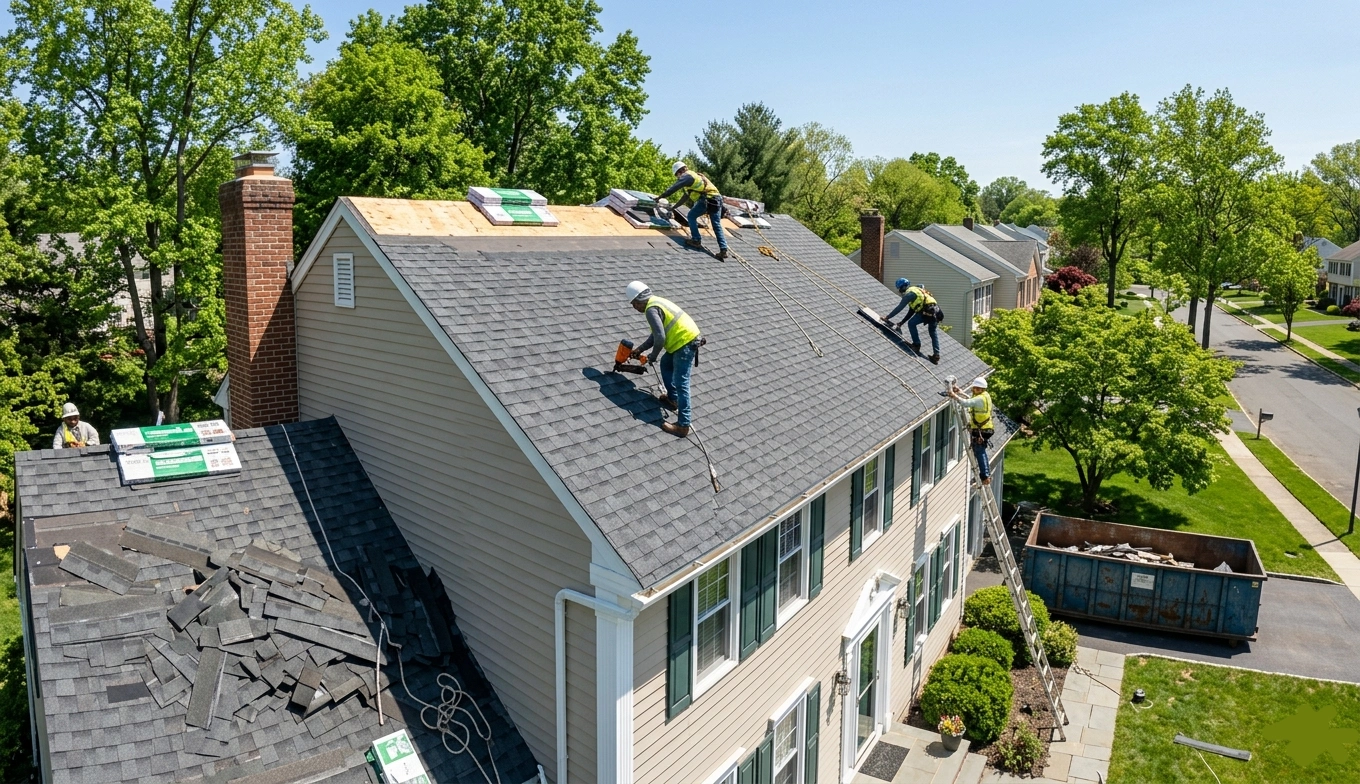
- Full tear-off of existing slate
- Decking replacement on the north slope (new plywood decking installed over the original plank)
- New slate installation (Vermont slate, 300-year natural cleft, same thickness as original)
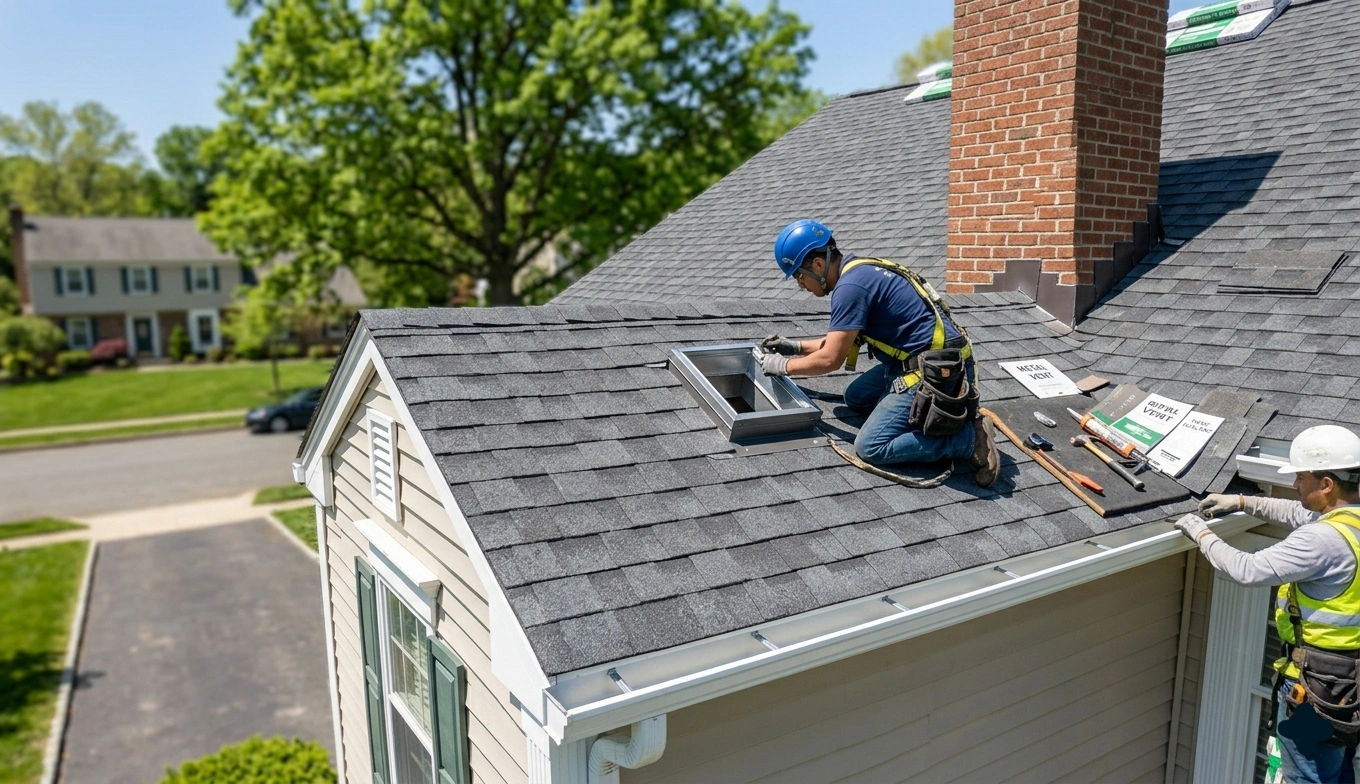
- Copper flashing throughout (period-appropriate)
- Ice and water shield on eaves and valleys
Project Sequence:
Days 1–3: Tear-off and decking replacement
Days 4–10: Slate installation (slow, meticulous process)
Days 11–12: Flashing, ridge caps, cleanup, inspection
Total Project Cost: $78,000
- Tear-off and disposal: $6,000
- Decking replacement: $4,000
- Slate materials (Vermont): $38,000
- Labor (12 days, 3-person crew): $25,000
- Copper flashing: $3,000
- Permit and fees: $2,000
Result: The roof passed Princeton’s Historic Preservation Commission review. The home’s curb appeal was restored. The homeowner is now protected for the next century.
Do You Need a Permit for Roof Replacement in Princeton, NJ?
Yes. Princeton requires construction permits for roof replacement under New Jersey’s Uniform Construction Code.
What requires a permit:
- Full roof replacement
- Any structural work (decking replacement, rafter repair)
- Any work that changes the roof’s appearance, material, or color (especially in historic districts)
What does NOT require a permit:
- Minor repairs (under 100 sq ft)
- Patch repairs that match existing materials
Historic district requirements:
- In addition to a construction permit, Historic Preservation Commission approval is required for material or color changes
- Some historic districts allow “like-for-like” replacement without full review, but you must confirm with the commission
- Your contractor should be familiar with Princeton’s historic preservation process
Never hire a roofer who suggests skipping the permit or historic review. In Princeton, the penalties for unapproved work can include fines and forced removal of non-compliant materials.
Frequently Asked Questions: Roof Replacement in Princeton, NJ
1. How much does a roof replacement cost in Princeton, NJ in 2026?
Most Princeton homeowners pay between $16,000 and $26,000 for premium architectural shingles on a non-historic home. Historic homes with slate replacement cost $50,000–$100,000+. Metal roofs run $38,000–$60,000.
2. Do I need a permit for roof replacement in Princeton?
Yes. Princeton requires construction permits under NJ UCC. If your home is in a historic district, you may also need Historic Preservation Commission approval for material or color changes. Your contractor should handle both.
3. Can I replace a slate roof with asphalt shingles in Princeton?
In most Princeton historic districts, no — asphalt shingles are not permitted on street-facing slopes of historic homes. Slate, metal, or wood are typically required. Check with the Historic Preservation Commission before making any material changes.
4. How long does a roof replacement take in Princeton?
Non-historic homes: 2–4 days. Historic homes with slate or metal: 10–14 days. The review process with the Historic Preservation Commission can add 4–6 weeks before work begins.
5. What is the best roofing material for a Princeton historic home?
Slate is the correct material for pre-1900 historic homes. It is historically accurate, lasts 75–150+ years, and preserves the home’s value. Standing seam metal is an acceptable alternative if slate is cost-prohibitive, provided it is approved by the Historic Preservation Commission.
6. Does homeowners insurance cover roof replacement in Princeton?
If the damage is from a covered peril (wind, hail, falling tree, fire), yes. Normal wear and tear, age, and neglect are not covered. Historic homes may have higher replacement costs than standard policies account for — review your policy carefully.
7. What is the ROI on roof replacement before selling in Princeton?
A historically accurate roof replacement (slate or metal) typically recoups 80–100% of its cost at resale in Princeton’s premium historic market. A non-historic replacement (architectural shingles) recoups 65–75%. Buyers in Princeton expect historic accuracy.
8. Can I replace my Princeton roof myself to save money?
No. Historic district requirements, steep pitches, and specialized materials make this a project for licensed professionals. Self-installation may violate historic district rules and can result in fines.
9. How do I find a trusted roofing contractor in Princeton?
Verify NJDCA license, confirm insurance, look for reviews from Princeton and Mercer County. Ask specifically about historic preservation experience and whether they have worked with Princeton’s Historic Preservation Commission. Avoid contractors who suggest asphalt shingles on a historic home.
10. How often should a roof be replaced in Princeton?
Slate: 75–150+ years. Metal: 40–70 years. Architectural shingles: 25–30 years. 3-tab shingles: 15–20 years (not recommended). Princeton’s historic homes with slate roofs are often 100+ years old and still functional.
11. What is the difference between natural slate and synthetic slate?
Natural slate is quarried stone. It is historically accurate for Princeton’s historic homes, lasts 75–150+ years, and costs $2,000–$4,000 per square. Synthetic slate is a composite material. It looks similar but is less durable and may not be approved in historic districts. For Princeton’s historic homes, natural slate is the correct choice.
12. What colors are allowed on Princeton roofs in historic districts?
Dark, muted colors: dark grey, charcoal, dark brown, dark green, or copper. Light colors and bright shades are typically not approved. Your contractor can confirm specific color requirements with the Historic Preservation Commission.