

The contractor pulled into the driveway on Broad Street and saw it immediately. The south-facing slope of the ranch had shingles that were curling so badly they looked like potato chips. Granules covered the gutters and the downspouts were clogged. The homeowner had been patching leaks for three years. “I thought I was saving money,” she said. “Instead, I’ve paid for half a new roof in repairs and still need a full replacement.”
That is the specific situation that defines Eatontown’s roofing market right now. The borough has a genuine mix of housing stock: post-war ranches and Cape Cods from the 1950s–1960s, larger colonials from the 1970s–1990s, and newer developments near the former Fort Monmouth property. Many of these roofs are now 25–40 years old, and homeowners are facing the same question: repair again, or replace properly.
This guide covers what roof replacement actually costs in Eatontown in 2026, how to handle storm damage claims, what materials work best for Eatontown’s climate, and how to find a roofer who stands behind their work.
Why Eatontown Homeowners Are Replacing Roofs in 2026
Eatontown’s housing stock spans three distinct eras, and each is hitting roof replacement age for different reasons.
Post-war ranches and Cape Cods (1950s–1960s) dominate neighborhoods near Broad Street and the former Fort Monmouth area. These homes were built with 3-tab shingles that were replaced once in the 1980s or 1990s. That second layer is now 25–40 years old. These roofs are failing from plain old age, not storm damage.
Colonials and larger homes (1970s–1990s) fill the neighborhoods off Route 35 and around the Eatontown Shopping Center. Original roofs are 30–50 years old. Many have been patched but never fully replaced. Decking underneath is often compromised from years of minor leaks.
Newer developments near Fort Monmouth have roofs that are 15–25 years old. These are not urgent yet, but homeowners are starting to plan ahead. The builder-grade shingles installed during the construction boom are showing early signs of wear.
Spring 2026 has added urgency. Eatontown has seen multiple wind and hail events in the past two years. Insurance claims are up. Homeowners who have been putting off replacement are now being forced to decide.
How Much Does Roof Replacement Cost in Eatontown, NJ in 2026?
Eatontown pricing sits in the middle of Monmouth County — higher than inland towns but lower than coastal towns like Sea Girt.
| Roof Type | Cost Per Square (100 sq ft) | Average Home (25–30 squares) |
| Architectural shingles (standard) | $550 – $800 | $13,750 – $22,000 |
| Architectural shingles (premium, algae-resistant) | $650 – $950 | $16,250 – $26,000 |
| 3-tab shingles (budget, not recommended) | $400 – $600 | $10,000 – $16,000 |
| Metal (standing seam) | $1,400 – $2,200 | $35,000 – $55,000 |
| Metal (stone-coated steel) | $1,000 – $1,600 | $25,000 – $40,000 |
Eatontown context:
- Post-war ranches with simple gable roofs are at the lower end of the range
- Larger colonials with multiple valleys and dormers add $2,000–$4,000 in labor
- Homes near Fort Monmouth with flat or low-slope sections may require modified bitumen in addition to shingles
Full tear-off vs. overlay:
- Overlay (shingles over existing layer): saves $2,000–$4,000 but is rarely allowed in Eatontown due to code restrictions (max two layers)
- Full tear-off (remove existing to decking): standard and recommended
What Are the Signs Your Eatontown Home Needs a New Roof?
Eatontown’s housing diversity means warning signs vary by home age and construction method.
Post-War Ranches and Cape Cods (1950s–1960s)
- Shingle age of 25+ years regardless of visible condition
- Curling or clawing shingle tabs on south and west exposures
- Granule loss visible in gutters
- Moss or algae growth that has returned within one year of cleaning
- Roof age unknown because records are incomplete
Colonials and Larger Homes (1970s–1990s)
- Roof age of 20+ years (original or first replacement)
- Missing shingles after any wind event, not just major storms
- Dark algae streaking on north-facing slopes
- Granule accumulation in downspouts
- Neighbors getting new roofs after the same storm
All Eatontown Homes
- Interior ceiling staining following rain or snowmelt
- Daylight visible through roof boards from the attic
- Increased energy bills with no other changes
- Visible sagging along the ridge line
- Shingles that are cracked, blistered, or buckling
Insurance and Storm Damage: An Eatontown-Specific Guide
Eatontown has seen more insurance claims in the past two years than in the previous five combined. Here is how to handle it correctly.
What Storm Damage Looks Like
- Dented metal flashing, vents, or gutters (hail damage)
- Shingles with soft, bruised appearance when felt by hand
- Granule loss concentrated in random patches, not uniform aging
- Creased shingles where wind has lifted and snapped the fiberglass mat
- Missing shingles that were not already loose
What to Do After a Storm in Eatontown
- Document everything – take dated photos from the ground and from a ladder (safely)
- File a claim promptly – most policies have time limits (6–12 months from storm date)
- Get a contractor’s inspection before the adjuster arrives – a good roofer will walk the roof with the adjuster
- Do not sign a contract with a door-knocker – storm chasers flood Eatontown after every storm
Understanding Your Insurance Check
- Actual Cash Value (ACV) policy – you get replacement cost minus depreciation; cheaper monthly premium but larger out-of-pocket
- Replacement Cost Value (RCV) policy – you get full replacement cost after completing the work; more common in Eatontown
- Recoverable depreciation – the amount held back until you provide proof of completed work; expires if you don’t finish in time
Eatontown’s Specific Insurance Context
Homes with older roofs (20+ years) may receive partial claims or denials based on pre-existing wear. A local roofer who has worked with Eatontown claims can help you navigate this.
Best Roofing Materials for Eatontown, NJ Homes in 2026
Eatontown’s climate has hot humid summers, cold winters, and occasional coastal storm influences. Material choices matter.
Architectural Shingles (Standard Recommendation)
Best for: 90% of Eatontown homes
Lifespan: 25–30 years
Cost: $$ (moderate)
Pros: Good wind resistance (130 mph available), decent algae resistance on premium lines, widely available, easy to repair
Cons: Not as durable as metal, shorter lifespan than premium materials
Eatontown note: GAF Timberline HDZ and CertainTeed Landmark are the two most common and both perform well. Pay the extra $200–$500 for algae-resistant granules – Eatontown’s humidity causes black streaking on north-facing slopes within 5–7 years without it.
Metal Roofing (Standing Seam)
Best for: Long-term owners (15+ years), homes with low-slope sections
Lifespan: 40–70 years
Cost: $$$$ (high)
Pros: Extremely durable, excellent for snow shedding, reflective coatings reduce cooling costs, handles hail better than shingles
Cons: High upfront cost, specialized installers required, can be noisy without solid decking
Eatontown note: Metal makes the most sense on larger colonials where the owner plans to stay long-term. It does not make financial sense on a starter home you will sell in 7 years.
3-Tab Shingles (Not Recommended)
Lifespan: 15–20 years
Cost: $ (low)
Pros: Cheapest option
Cons: Look cheap, lower wind resistance, shorter lifespan, poor curb appeal
Eatontown note: Almost no legitimate contractor recommends 3-tab anymore except for sheds or garages. Do not put 3-tab on a primary residence in Eatontown.
Do You Need a Permit for Roof Replacement in Eatontown, NJ?
Yes. Eatontown Borough requires construction permits for roof replacement under New Jersey’s Uniform Construction Code.
What requires a permit:
- Full roof replacement on any residential structure
- Any work that involves removing and replacing roof covering materials
- Structural modifications to the roof framing
What does NOT require a permit:
- Minor roof repairs (under 100 sq ft)
- Simple patching of a small area
Who pulls the permit: Your contractor should pull the permit and schedule the inspection. Never hire a roofer who asks you to pull your own permit.
The Eatontown process:
- Your contractor submits the application to the Eatontown building department
- Inspection follows completion (decking condition, underlayment, flashing, shingle attachment)
- The borough inspects before final approval
Real Project: Roof Replacement in Eatontown, NJ
Case Study: Broad Street Area Ranch, Eatontown
Property: 1,800 sq. ft. Ranch, built 1958
Location: Broad Street area, Eatontown Borough, Monmouth County
Pre-Project Condition: Original 3-tab shingles from a 1980s replacement, now 38 years old. Widespread curling on south slope. Granules missing entirely on west-facing sections. Two active leaks: one over the living room, one over the garage. Homeowner had patched both three times in the last 5 years.
Homeowner Goal: Stay in the home for another 10–12 years. Wants a reliable roof with no more patches. Budget is a factor but willing to pay for quality.
Findings:
- Full tear-off revealed deteriorated decking on the south slope (approximately 8 sheets of plywood needed replacement)
- No structural damage beyond decking
- Attic ventilation was inadequate (only 4 soffit vents for a 1,800 sq ft home)
Solution:
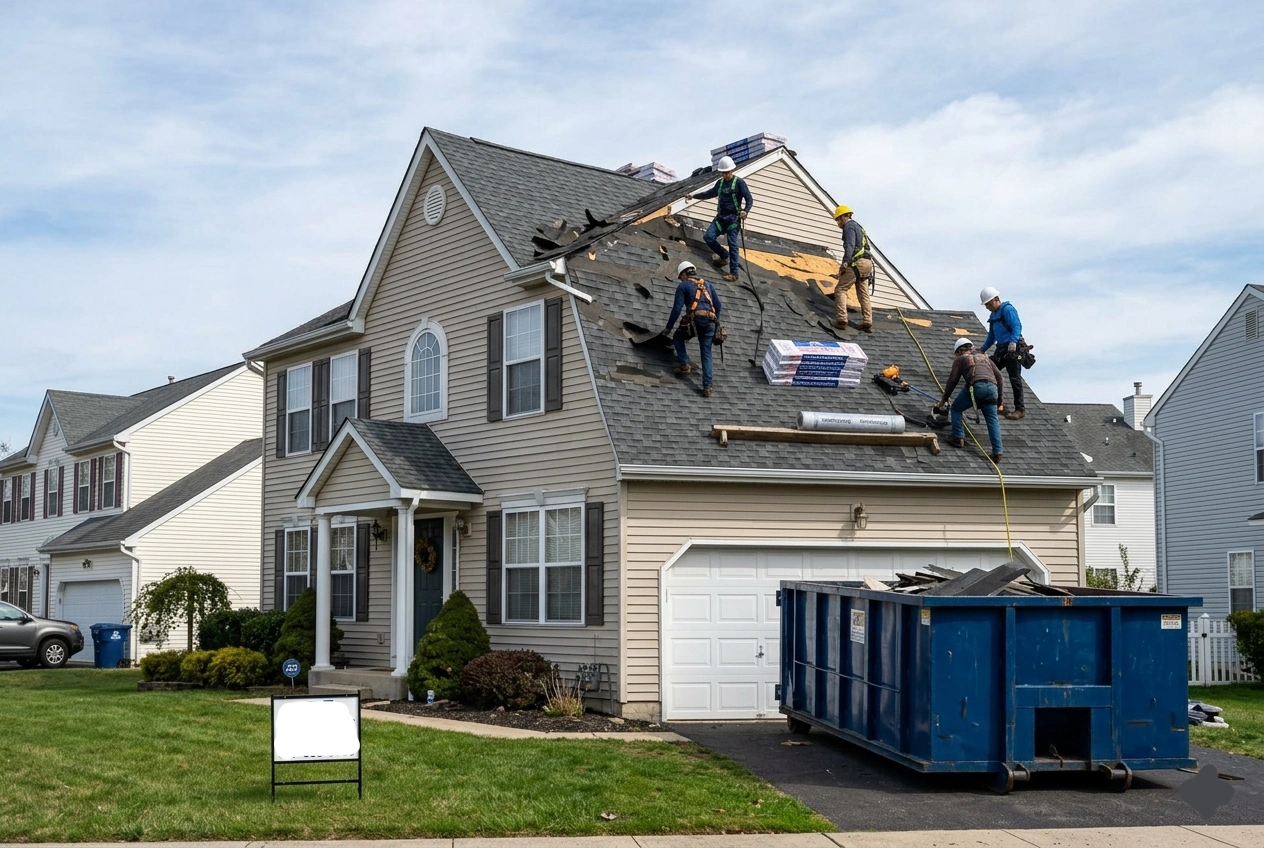
- Full tear-off of existing 3-tab (1,800 sq ft = 18 squares)
- 8 sheets of plywood decking replaced on south slope
- Ice and water shield installed on eaves, valleys, and around all penetrations
- New synthetic underlayment over the remainder
- Architectural shingles (GAF Timberline HDZ, algae-resistant, 130 mph wind rating)
- Added 4 new soffit vents and ridge vent to balance attic ventilation
Project Sequence:
Day 1: Tear-off and decking replacement
Day 2: Underlayment, ice and water shield, starter shingles
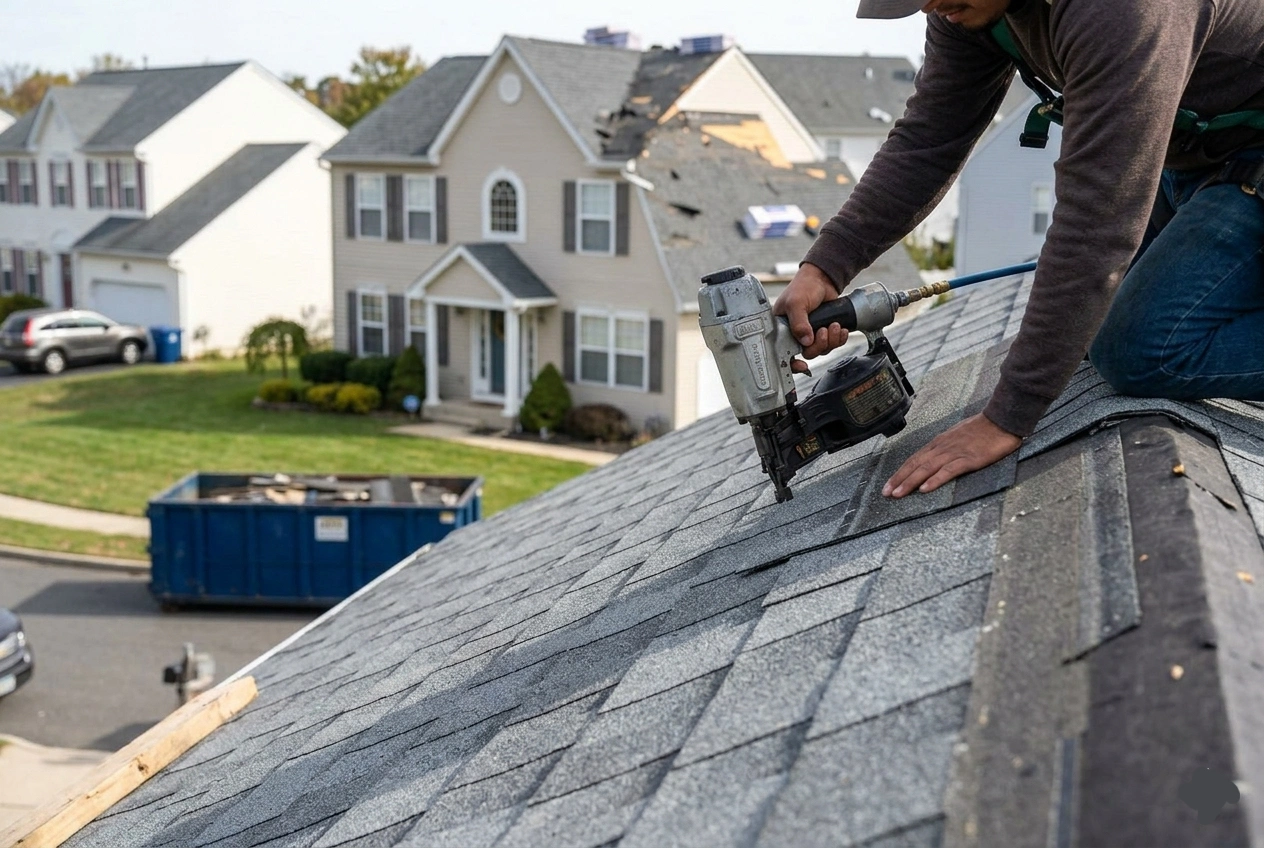
Day 3: Main shingle installation
Day 4: Ridge caps, flashing, cleanup, inspection
Total Project Cost: $14,200
- Tear-off and disposal: $2,200
- Decking replacement (8 sheets): $1,200
- Shingles and materials: $6,500
- Labor: $3,500
- Ventilation upgrade: $600
- Permit: $200
- Contingency (actual): $0 under
Result: Roof passed Eatontown inspection on the first attempt. Homeowner reported no leaks through the following spring rainy season. The algae-resistant shingles have kept the north slope clean. The homeowner plans to stay for another 10+ years and will get full value from the investment.
How Do I Find a Trusted Roofing Contractor in Eatontown, NJ?
Eatontown is targeted by storm chasers after every nor’easter. Here is how to separate legitimate local roofers from fly-by-night operations.
Verify Before Scheduling:
- NJ Home Improvement Contractor license – verify at njconsumeraffairs.gov
- General liability and workers compensation – ask for certificates
- Physical address in Monmouth or adjacent county (not a PO box or out-of-state address)
- Reviews from Eatontown, Tinton Falls, Shrewsbury, or Red Bank from the past 12 months
Questions to Ask for an Eatontown Roofing Project:
- Will you pull the permit and schedule the inspection with Eatontown Borough?
- Do you handle insurance claims directly, and will you meet the adjuster on site?
- What brand and specific shingle line do you recommend, and why?
- What does your workmanship warranty cover, and for how long (5 years minimum, 10 is better)?
- Do you subcontract labor, or do you have W-2 employees?
- Can you provide three references from Eatontown within the last 18 months?
- What happens if you discover decking rot during tear-off – how is that priced?
Red Flag Responses:
- “You don’t need a permit in Eatontown” (false – permits are required)
- “We can use your leftover claim money for a deductible credit” (insurance fraud)
- “Sign today and we waive the deductible” (illegal in New Jersey)
- “We’re working in your neighborhood and have extra materials” (classic storm chaser script)
Frequently Asked Questions: Roof Replacement in Eatontown, NJ
1. How much does a roof replacement cost in Eatontown, NJ in 2026?
Most Eatontown homeowners pay between $13,000 and $22,000 for an architectural shingle roof on a typical 1,800–2,500 sq. ft. home. Complex roofs (steep pitches, multiple valleys) run $20,000–$28,000. Metal roofs start at $25,000 and go to $55,000+.
2. Do I need a permit for roof replacement in Eatontown Borough?
Yes. Eatontown requires a construction permit under NJ UCC. Your contractor should pull the permit and schedule the inspection. Never let a roofer talk you into pulling your own permit – that makes you the contractor of record and liable for any code violations.
3. How long does a roof replacement take in Eatontown?
A typical home takes 2–4 days. Simple ranch or Cape Cod with a gable roof: 2 days. Complex roof with multiple valleys, dormers, or steep pitches: 3–4 days. Full tear-off with decking replacement: add 1–2 days.
4. Can I put a second layer of shingles over my existing roof in Eatontown?
Eatontown allows one overlay (second layer) if the existing layer is sound and total layers do not exceed two. Most reputable contractors recommend full tear-off regardless of code because overlays hide decking rot and shorten the new roof’s lifespan.
5. Does homeowners insurance cover roof replacement in Eatontown?
Yes, if the damage is from a covered peril (wind, hail, falling trees, fire). Normal wear and tear, age, and neglect are not covered. After recent nor’easters, many Eatontown homeowners received approved claims. File promptly and get a contractor’s inspection before the adjuster arrives.
6. What is the best shingle brand for Eatontown homes?
GAF Timberline HDZ and CertainTeed Landmark are the most common and both perform well in Eatontown’s climate. Pay the extra $200–$500 for algae-resistant granules – Eatontown’s humidity and north-facing slopes develop black streaking within 5–7 years without it.
7. Should I replace my roof before selling my Eatontown home?
If your roof is 20+ years old or shows visible damage, yes. Eatontown buyers are educated and inspectors will flag an aging roof. A $14,000–$18,000 replacement typically recoups 65–75% at sale, but more importantly it prevents $5,000–$15,000 in repair credits or a cancelled contract.
8. How do I spot a storm chaser roofer in Eatontown?
Red flags: door-knocking without an appointment, “leftover materials from a job nearby,” out-of-state license plates, pressure to sign today, asking you to pull your own permit, offering to waive your deductible (illegal in NJ), or not having a physical office in Monmouth County.
9. What is the difference between architectural shingles and 3-tab shingles?
Architectural shingles are thicker, have a layered appearance, last 25–30 years, and offer better wind resistance (130 mph). 3-tab shingles are flat, uniform, look cheaper, last 15–20 years, and are not recommended for primary residences in Eatontown.
10. Is metal roofing worth the extra cost in Eatontown?
Metal makes sense if you plan to stay in your Eatontown home for 15+ years, have a larger colonial, or have low-slope sections where shingles perform poorly. It does not make financial sense on a starter home or a property you will sell within 10 years.
11. How do I file an insurance claim for storm damage in Eatontown?
First, document damage with dated photos. Second, get a contractor’s inspection before calling your insurer. Third, file the claim promptly (time limits apply). Fourth, have your contractor meet the adjuster on the roof. Fifth, do not sign anything with a door-knocker before your claim is approved.
12. What is recoverable depreciation, and why does it expire?
If you have a Replacement Cost Value (RCV) policy, your initial check is for Actual Cash Value (replacement cost minus depreciation). The withheld amount is recoverable depreciation – you get it back after completing the work and providing proof. It typically expires 120 days to one year from the claim date. Miss the deadline and you lose that money permanently.
13. Can a roofer inspect my roof for free in Eatontown?
Yes, legitimate roofers offer free inspections. Be skeptical of anyone who charges for an initial inspection. But also be skeptical of free inspections that turn into high-pressure sales pitches. A good roofer will walk your roof, show you photos of damage, explain options, and leave you alone to decide.
14. What happens if my roofer finds rotted decking during tear-off?
Standard practice: the contract includes a per-sheet price for OSB or plywood replacement (typically $100–$150 per sheet in Eatontown). You pay only for what is actually needed. A good contractor will show you photos of the rot before replacing. Expect 5–15 sheets on a typical Eatontown home built before 1980.
15. How often should a roof be replaced in Eatontown?
Architectural shingles: 25–30 years. 3-tab shingles: 15–20 years. Metal: 40–70 years. Eatontown’s climate is average for New Jersey – neither especially hard nor easy on roofs. Most homes in Eatontown built in the 1950s–1960s are due now if they haven’t been replaced.