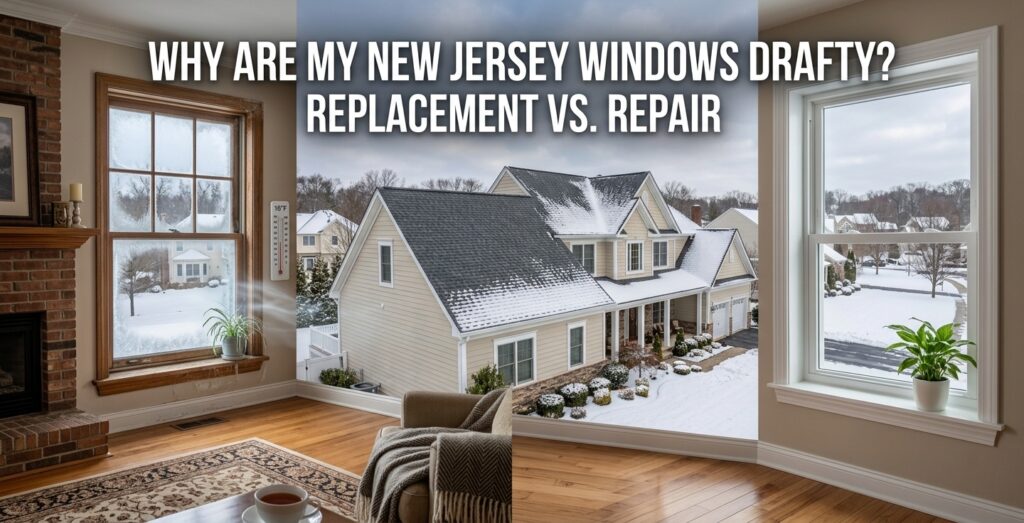


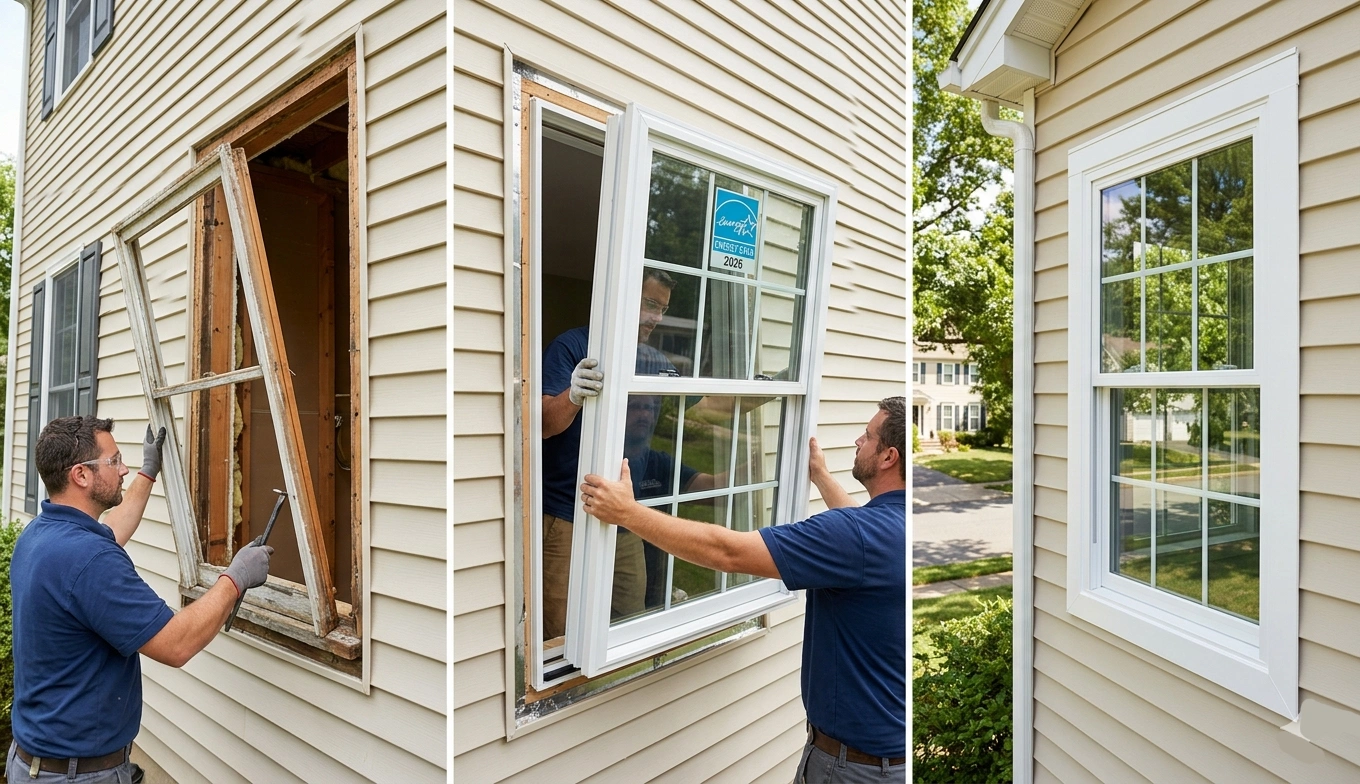
The homeowner in the Lincroft section of Middletown Township sat in the living room of the 1980s colonial and watched the curtains move. The window was closed. The lock was engaged. But the draft was strong enough to make the drapes sway. “We’ve replaced the HVAC, upgraded the insulation, and sealed every crack we could find,” they said. “The windows are the last thing. And they’re the biggest problem.”
That is the specific situation that defines window replacement in Lincroft. The community has some of Monmouth County’s most desirable properties: higher-end colonials, custom homes, and historic farmhouses set on larger lots. Buyers in Lincroft are sophisticated and discerning. They notice window quality. They understand the difference between budget vinyl and premium fiberglass. And they expect the best.
This guide covers what window replacement actually costs in Lincroft in 2026, what materials match the quality of Lincroft’s homes, how to handle historic farmhouse properties, and how to find a contractor who works at Lincroft’s level.
Why Lincroft Homeowners Are Replacing Windows in 2026
Lincroft has three distinct housing types, and each is hitting window replacement age for different reasons.
Historic farmhouses and pre-war colonials (scattered throughout Lincroft’s larger lots) often have original wood windows or early aluminum replacements. These homes have character and detail that cheap vinyl windows would destroy. Owners are looking for historically appropriate replacements that maintain the home’s integrity.
1970s–1990s colonials and custom homes dominate Lincroft’s subdivisions. These homes were built with aluminum or early vinyl windows that are now 30–50 years old. The seals have failed. Fogging is visible. Frames are corroded or warped. These homeowners are ready to upgrade.
2000s custom homes have windows that are 20–25 years old. These were often builder-grade vinyl, not the premium quality the home deserves. Owners are replacing them earlier than expected to match the home’s quality and improve energy efficiency.
Lincroft’s higher-end market changes the window conversation. In many towns, homeowners are looking for the cheapest acceptable option. In Lincroft, homeowners are looking for the best long-term investment. Premium materials (fiberglass, wood-clad, composite) are the standard, not the exception.
How Much Does Window Replacement Cost in Lincroft, NJ in 2026?
Lincroft pricing is at the high end of Monmouth County. Higher-end materials are the norm, not the exception. Labor reflects the quality expectations of the community.
| Frame Material | Cost Per Window (Installed) | Best For |
| Vinyl (pocket) | $500 – $850 | Budget projects, rental properties (rare in Lincroft) |
| Vinyl (full frame, premium) | $750 – $1,200 | Lower-end Lincroft homes, budget-conscious |
| Fiberglass | $1,000 – $1,800 | Standard recommendation for most Lincroft homes |
| Wood (clad exterior, premium) | $1,200 – $2,200 | Historic farmhouses, high-end custom homes |
| Composite | $900 – $1,500 | Good mid-range option for Lincroft |
| Aluminum-clad wood (ultra-premium) | $1,500 – $2,500 | Top-tier custom homes, architectural restoration |
Full home estimates (14–20 windows typical for Lincroft’s larger homes):
- Vinyl full frame (premium): $11,000 – $20,000
- Fiberglass full frame: $16,000 – $30,000
- Wood-clad: $18,000 – $38,000
- Aluminum-clad wood (ultra-premium): $25,000 – $45,000
Lincroft context:
- Larger windows and non-standard openings are common (Lincroft homes often have oversized windows for light and views)
- Custom sizing adds $200–$500 per window
- Historic farmhouses may have non-standard shapes (arches, tall casements) that require custom manufacturing
- Higher-end properties often include upgraded glass packages (triple-pane, low-E, argon/krypton)
What Are the Signs Your Lincroft Home Needs Window Replacement?
Lincroft’s housing diversity means warning signs vary by home age and quality.
Historic Farmhouses and Pre-War Colonials
- Single-pane glass still in place anywhere
- Wood rot at sills, especially on south and west exposures
- Rope-and-pulley systems that no longer function
- Visible gaps between the window frame and the rough opening
- Condensation forming on interior glass on cold mornings
- Drafts strong enough to move curtains
1970s–1990s Colonials and Custom Homes
- Fogging between double-pane glass on any window
- Aluminum frames showing corrosion at the corners
- Windows that will not stay open or closed on their own
- Rising heating and cooling bills with no other changes
- Visible light around the perimeter of closed windows
- Hardware (locks, handles, balances) that is broken or difficult to operate
2000s Custom Homes
- Vinyl frames showing yellowing or warping from UV exposure
- Seal failures visible as cloudy glass on south or west exposures
- Noise transmission that has increased noticeably
- Condensation forming on interior glass (indicating seal failure)
All Lincroft Homes
- Interior moisture staining on walls near windows
- Visible daylight around closed windows
- Exterior trim that is rotting or deteriorating
- Energy bills that have increased despite no changes
Full Frame vs. Pocket Replacement: Which One Does Lincroft Need?
This is the single most important technical decision in a Lincroft window project.
Pocket replacement (insert windows) installs a new window inside the existing frame. It is faster, cheaper, and less invasive. It works well when the existing frame is structurally sound, square, and free of rot or damage.
Full frame replacement removes the entire window down to the rough opening, installs new framing if needed, and sets a completely new window. It costs more and takes longer, but it is the only correct choice when the existing frame has failed.
Lincroft decision guide:
| Home Type | Recommended Method | Why |
| Historic farmhouse (original wood) | Full frame | Original frames are almost always compromised after 80–150 years |
| Historic farmhouse (replaced 1980s–1990s) | Inspect first; often pocket | Frames may still be sound |
| 1970s–1990s colonial (aluminum original) | Full frame | Aluminum frames corrode and warp; rarely salvageable |
| 1970s–1990s colonial (vinyl 1990s) | Pocket if frames sound | Vinyl frames hold up well if not damaged |
| 2000s custom home (builder-grade vinyl) | Frames are typically still square and sound |
Lincroft-specific consideration: Many Lincroft homes have larger-than-standard window openings (custom sizes for architectural effect). Full frame replacement is often required because custom-sized pocket inserts may not be available or may look proportionally wrong.
Best Window Materials for Lincroft, NJ Homes in 2026
Lincroft’s higher-end market demands better materials. Here is what works.
Fiberglass — STANDARD RECOMMENDATION FOR MOST LINCROFT HOMES
Best for: 70% of Lincroft homes (1970s–2000s colonials and custom homes)
Lifespan: 30–50 years
Cost: $$$ (high)
Pros: Very rigid, excellent thermal performance, paintable, looks closest to wood, does not expand or contract, handles large openings well
Cons: Higher cost than vinyl
Lincroft note: Fiberglass is the sweet spot for Lincroft. It delivers the quality that Lincroft homeowners expect without the maintenance of wood. Worth the premium.
Wood (Clad Exterior) — FOR HISTORIC FARMHOUSES AND ULTRA-PREMIUM HOMES
Best for: Historic farmhouses, high-end custom homes, architectural restoration
Lifespan: 20–40 years
Cost: $$$$ (very high)
Pros: Authentic look, traditional operation, highest curb appeal
Cons: Most expensive, requires maintenance (exterior cladding helps but interior wood still needs care)
Lincroft note: Lincroft’s historic farmhouses demand wood for authenticity. Aluminum-clad wood (Marvin, Andersen) is the correct specification for these properties.
Composite — GOOD MID-RANGE OPTION
Best for: 1970s–1990s colonials, budget-conscious high-end
Lifespan: 25–40 years
Cost: $$–$$$ (moderate to high)
Pros: Stronger than vinyl, less expensive than fiberglass, good thermal performance
Cons: Fewer manufacturers, less proven long-term
Lincroft note: A solid choice for Lincroft’s 1970s–1990s colonials if fiberglass is out of budget.
Vinyl (Premium) — ONLY FOR BUDGET PROJECTS
Best for: Rental properties, budget-conscious homeowners
Lifespan: 20–30 years
Cost: $$ (moderate)
Pros: Lowest cost, no maintenance, good energy efficiency
Cons: Can warp, not as rigid as fiberglass, lower curb appeal
Lincroft note: Premium vinyl with reinforced frames is acceptable for lower-end Lincroft homes but is not the quality level most Lincroft buyers expect. Fiberglass is the better long-term investment.
Lincroft’s Historic Farmhouses: A Special Case
Lincroft has several historic farmhouses on large lots, some dating back to the 1700s and 1800s. These require special consideration.
What makes a Lincroft home “historic” in this context:
- Built before 1900 (often 1700s–1800s farmhouses)
- Original wood siding, windows, and architectural details
- Located on larger lots with agricultural history
What changes for window replacement on historic farmhouses:
- Vinyl is completely inappropriate (looks wrong, destroys character)
- Wood windows (with clad exterior) or fiberglass are the only acceptable materials
- Window profiles (divided lites, muntin patterns, hardware) must match the historic character
- Non-standard sizes and shapes (arches, tall casements) are common
- Full frame replacement is almost always required
Practical advice: Do not replace windows on a Lincroft historic farmhouse with anything that doesn’t match the original character. Future buyers of these properties are looking for authenticity. A cheap vinyl window on a 1700s farmhouse will reduce the home’s value more than it saves.
Do You Need a Permit for Window Replacement in Lincroft (Middletown Township), NJ?
Yes. Middletown Township (which includes Lincroft) requires permits for window replacement under New Jersey’s Uniform Construction Code.
No permit typically required:
- Like-for-like replacement in the same opening
- Same window type and size
- No structural changes to the rough opening
Permit typically required:
- Enlarging or reducing an opening
- Changing window type (casement to double-hung, etc.)
- Modifying the header or structural framing
Middletown Township process:
- Your contractor pulls the permit from the Middletown Township building department
- Inspection follows completion (flashing, sealing, attachment)
- Historic farmhouses may receive additional scrutiny for historical appropriateness
A qualified contractor will handle permit filing and advise you on any historic considerations.
Real Project: Window Replacement in Lincroft, NJ
Case Study: Lincroft Section, Middletown Township
Property: 3,000 sq. ft. Colonial, built 1988
Location: Lincroft section, Middletown Township, Monmouth County
Pre-Project Condition: Original aluminum windows (16 units). Fogging visible in 10 units. Frames corroded on south and west exposures. Drafts detectable throughout the home. Homeowner had replaced HVAC and insulation but still had high energy bills.
Homeowner Goal: Stay in the home for another 15–20 years. Wants premium windows that will last, improve energy efficiency, and enhance curb appeal.
Findings:
- Aluminum frames were corroded on south and west exposures
- 10 of 16 windows showed seal failure (fogging)
- No rot or structural damage — frames were sound enough for pocket replacement, but homeowner chose full frame for performance
Solution:
- 16 fiberglass double-hung windows, full frame
- Triple-pane glass with Low-E and argon (for maximum energy efficiency)
- U-factor 0.22, SHGC 0.25 (exceeds code requirements)
- Custom divided lites on front-facing windows to match the home’s colonial character
- New flashing and sealant throughout
Project Sequence:
Day 1: Front facade full frame replacement
Day 2: Rear elevation
Day 3: Side elevations
Day 4: Trim, caulking, cleanup, inspection
Total Project Cost: $28,800
- 16 fiberglass windows (full frame): $24,000
- Triple-pane upgrade: $1,600
- Custom divided lites: $1,200
- Trim repair: $1,200
- Permit and disposal: $400
- Contingency (actual): $400 under
Result: Homeowner reported significantly reduced drafts. Heating bills dropped approximately 20% the following winter. The custom divided lites enhanced the home’s colonial character. The homeowner plans to stay 15+ years and will get full value from the premium windows.
How Do I Find a Trusted Window Contractor in Lincroft, NJ?
Lincroft’s higher-end market requires a contractor who works at that level. Here is how to find the right one.
Verify Before Scheduling:
- NJDCA contractor license — verify at njconsumeraffairs.gov
- General liability and workers compensation — ask for certificates
- Physical address or established history in Monmouth County
- Reviews from Lincroft, Middletown, Holmdel, or Rumson from the past 12 months
Questions to Ask for a Lincroft Window Project:
- Do you work on higher-end homes in Lincroft? What premium windows do you offer?
- Do you recommend fiberglass or wood for my home’s character?
- Can you provide a written spec for glass performance (U-factor, SHGC)?
- Will you handle the permit filing with Middletown Township?
- Do you subcontract installation or use your own crew?
- Can you provide three references from Lincroft or similar Monmouth County towns?
- What does your labor warranty cover, and for how long?
- Do you have experience with historic farmhouse windows if needed?
Red Flag Responses:
- “Vinyl is fine for any home in Lincroft” (false — fiberglass or wood is expected)
- “You don’t need a permit in Middletown” (false — permits are required)
- “All windows are the same” (false — quality varies enormously)
- “We can do your 16 windows in one day” (possible but usually means rushed work)
FAQ Section: Window Replacement in Lincroft, NJ (16 Questions)
1. How much does window replacement cost in Lincroft, NJ in 2026?
Most Lincroft homeowners pay between $1,000 and $2,000 per window installed for premium materials. A full home (14–20 windows) typically runs $16,000 to $38,000. Fiberglass is the standard recommendation ($1,000–$1,800 per window). Wood-clad runs $1,200–$2,200. Vinyl (premium) is the budget option at $750–$1,200.
2. Do I need a permit for window replacement in Lincroft (Middletown Township)?
Like-for-like replacement in the same opening typically does not require a construction permit. Enlarging openings, changing window types, or modifying headers does require a permit. Your contractor should pull the permit if required. Never hire a contractor who suggests skipping permits.
3. What is the best window material for Lincroft homes?
Fiberglass is the standard recommendation for most Lincroft homes (1970s–2000s colonials and custom homes). It delivers the quality Lincroft homeowners expect without the maintenance of wood. Wood (clad exterior) is the correct choice for historic farmhouses. Vinyl (premium) is acceptable for budget projects but is not the quality level Lincroft buyers expect.
4. How long does window replacement take in Lincroft?
A typical home with 14–20 windows takes 3–5 days. Pocket replacement is faster (2–3 days). Full-frame replacement takes longer (4–6 days). Historic farmhouses with custom-sized or non-standard windows can take 5–7 days.
5. What is the difference between pocket and full-frame replacement?
Pocket replacement installs a new window inside the existing frame. It is faster and cheaper, but only works when the existing frame is sound. Full-frame replacement removes everything down to the rough opening. It is necessary when frames are rotted, warped, or corroded. Lincroft’s older homes often need full-frame.
6. Does window replacement increase home value in Lincroft?
Yes, significantly. Lincroft’s higher-end market means buyers are sophisticated and discerning. Fogged windows, drafty frames, or visible rot generate repair credits or price reductions. Premium windows (fiberglass or wood) tell buyers the home has been properly maintained. The ROI is typically 70–80% at resale in this market.
7. Are fiberglass windows worth the extra cost over vinyl in Lincroft?
Yes. Lincroft’s higher-end homes demand better materials. Fiberglass lasts 30–50 years, does not warp or corrode, and looks better than vinyl. Vinyl lasts 20–30 years and can look cheap on a premium home. The extra cost is small compared to the long-term value and curb appeal.
8. What is the difference between U-factor and SHGC?
U-factor measures how well a window prevents heat from escaping (lower is better for winter). SHGC measures how well a window blocks heat from the sun (lower is better for summer). Lincroft needs both: U-factor of 0.25 or lower, SHGC of 0.25–0.30. A good contractor will specify both in your quote.
9. What are the signs my Lincroft home needs window replacement?
On aluminum (1970s–1990s): corrosion at corners, fogging between panes, windows that don’t operate properly. On vinyl (2000s): yellowing or warping, seal failures, noise transmission. On wood (historic): rot at sills, single-pane glass, rope-and-pulley failure. On any home: drafts, moisture staining, rising energy bills.
10. What happens if my window contractor finds rot during installation?
Standard practice: the contract includes a per-linear-foot or per-window price for rot repair (typically $100–$300 per opening). You pay only for what is actually needed. A good contractor shows you photos before repairing. Expect rot on 20–40% of openings in Lincroft’s older homes.
11. Are vinyl windows allowed on Lincroft’s historic farmhouses?
Generally no on street-facing elevations. Vinyl is inappropriate for historic farmhouses. Wood (with clad exterior) or fiberglass are the only acceptable materials. Future buyers of historic Lincroft farmhouses are looking for authenticity, not cheap replacements.
12. What is the ROI on premium window replacement in Lincroft?
Premium window replacement (fiberglass or wood) typically recoups 70–80% of its cost at resale in Lincroft’s higher-end market. More importantly, it prevents $10,000–$20,000 in buyer repair credits or a cancelled contract. Lincroft buyers expect quality.
13. Can I replace windows myself in Lincroft to save money?
You can, but it is not recommended for most homeowners. Proper flashing and sealing are essential to prevent water damage. Manufacturer warranties often require professional installation. Historic farmhouses require specialized knowledge. Hire a licensed contractor for anything beyond a basic pocket replacement.
14. How do I find a trusted window contractor in Lincroft?
Verify NJDCA license, confirm insurance, look for reviews from Lincroft/Middletown/Holmdel/Rumson. Ask specifically about premium materials (fiberglass, wood) and historic farmhouse experience. Avoid contractors who say “vinyl is fine for any home” or “all windows are the same.”
15. How often should windows be replaced in Lincroft?
Fiberglass: 30–50 years. Wood: 20–40 years with maintenance. Vinyl (premium): 20–30 years. Aluminum (original): 25–40 years but often fails earlier. Lincroft’s 1970s–1990s colonials with aluminum windows are due now. Historic farmhouses with original windows are already 100+ years old and well past replacement age.
16. What is the best glass package for Lincroft’s climate?
Triple-pane with Low-E and argon is the premium choice for Lincroft’s cold winters. U-factor of 0.22 or lower, SHGC of 0.25–0.30. The extra cost is worth it for Lincroft’s larger homes with high energy bills. Double-pane with Low-E and argon is acceptable if budget is a concern.
17. Can one contractor handle all my Lincroft home’s exterior projects?
Yes. Many Lincroft homeowners combine window replacement with siding and roofing. The right sequence is roof first, windows second, siding last. One contractor handling all three means one permit coordination, one warranty covering intersections, and one point of accountability.
18. Does homeowners insurance cover window replacement in Lincroft?
If the damage is from a covered peril (wind, hail, falling tree, fire, vandalism), yes. Normal wear and tear, age, and neglect are not covered. Document damage with photos and file promptly if storm-related.